
This Post is brought to you by Semrush.
Google’s AI Overviews now control 40% of local search results. If you’re an SEO professional, that number should get your attention. The game has changed.
Traditional SEO skills still matter. Keywords, backlinks, rankings—you know these well. But there’s a new challenge: How do you optimize content so AI tools actually cite your brand?
Should you focus on breaking content into smaller chunks? Does structured data help? What quality signals do AI models look for? These questions are urgent, and the uncertainty is real.
The good news is that getting cited in AI search isn’t luck. It’s strategy.
And this guide will show you exactly how to make it happen.
The New Search Landscape: Understanding AI-Powered Search
Search has evolved.
The platforms people use to find information have changed, and traditional tactics don’t guarantee visibility anymore.
Let’s understand what’s different.
What Is AI Search and Why It Matters
AI search changes how people find information online. Instead of seeing a list of blue links, users now see AI-generated summaries.
These summaries pull information from multiple sources and present it as one answer. Like this:
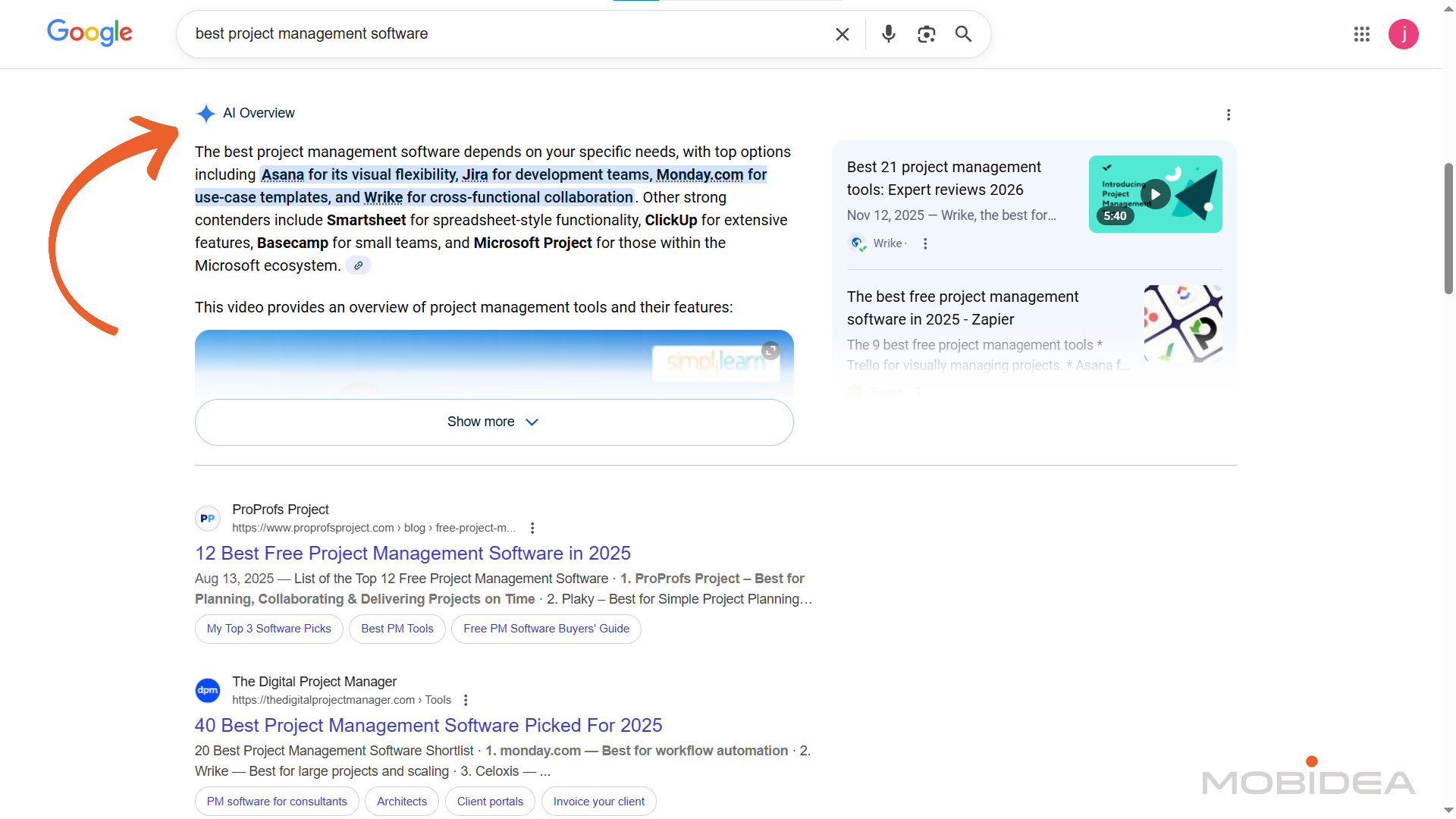
Here are the main AI search platforms:
- Google AI Overviews – AI-generated answers in Google search results
- ChatGPT Search – OpenAI’s search feature with cited sources
- Perplexity – AI search engine that provides sourced answers
- Google AI Mode – Conversational search with AI responses
- Claude – Anthropic’s AI assistant with search capabilities
- Gemini – Google’s AI integrated with search
Let’s say someone searches for “best project management software” or “how to fix a leaky faucet.”
They’ll often see an AI-generated answer before traditional search results.
For many queries, the AI answer IS the answer.
Users don’t click through to websites anymore.
Here’s the key difference: Old search engines looked for exact keywords on your page.
AI search actually reads and understands your content. It looks at context, pulls relevant facts, and combines information from multiple sources.
We’ve moved from rankings to citations.
Being number one on page one isn’t the goal anymore. The goal is being the source that AI tools reference when they answer questions.
Three Core Questions SEOs Are Asking about AI Optimization
You’re not alone if you feel uncertain about AI optimization.
SEOs everywhere are asking the same questions:
- Should I focus on content chunking for AI consumption?
Content chunking means breaking your content into smaller, organized sections.
⬜ Does this help AI models find and cite it?
⬜ What’s the right balance between detailed content and easy-to-digest chunks?
⬜ Are there specific formatting patterns that work better?
- Do structured data and schema matter for AI citations?
Schema markup is code that helps search engines understand your content.
⬜ Will FAQ schema increase your chances of being cited?
⬜ Does article schema help AI models understand your content better?
⬜ Should you prioritize schema over other optimizations?
- What quality signals actually influence AI model selection?
⬜ Is it about authority and backlinks like traditional SEO?
⬜ Do AI models care more about how recent your content is or how comprehensive it is?
⬜ How much does your existing domain authority matter?
These aren’t simple yes-or-no questions. The answer is actually all three factors matter.
You need a data-driven approach to know which to prioritize for your specific content and industry.
The best SEO strategies today balance old rules with new reality.
You can’t ignore traditional SEO—organic search rankings still matter. There are still many people who are AI-averse and would quickly scroll down to ignore AI output.
But you also can’t ignore that millions of searches now end in AI-generated answers, not clicks to your site.
Let’s look at how to track your performance in this new landscape.
How to Track Your Brand’s AI Search Visibility
You can’t improve what you don’t measure. The first step to winning in AI search is understanding where you stand today.
Why does monitoring AI citations matter?
When AI tools cite your brand as a trusted source, you build credibility with users. These users might never click through to a traditional search result.
This visibility drives brand awareness, authority, and conversions.
What to Measure in AI Search
Traditional SEO taught us to track rankings, traffic, and conversions. AI search needs new metrics.
Here’s what matters now:
Citation frequency and context:
- How often does your brand get mentioned?
- What topics trigger citations to your content?
- Are you cited as a primary source or secondary reference?
Source attribution rates:
- When AI tools answer questions in your space, how often do they cite you versus competitors?
- What percentage of relevant queries include your content?
Share of voice in AI responses:
- For your core topics, are you the dominant source or one of many?
- Do you own specific subtopics or keyword areas?
Topic authority signals:
- Which subject areas consistently cite your content?
- Where are the gaps in your AI visibility?
- What topics do competitors own that you don’t?
Answer inclusion percentage:
- Out of 100 relevant queries, how many AI responses include your brand?
- Is your inclusion rate growing or shrinking over time?
These metrics tell a different story than traditional analytics.
You might have declining organic traffic but growing AI citations. Or the opposite. Both matter, but they need different strategies.
Manually Tracking AI Visibility
Right now, you can start tracking AI visibility manually.
Here’s a quick guide on how to do that:
1. Pick 20-30 queries relevant to your business.
2. Search them in various AI search platforms.
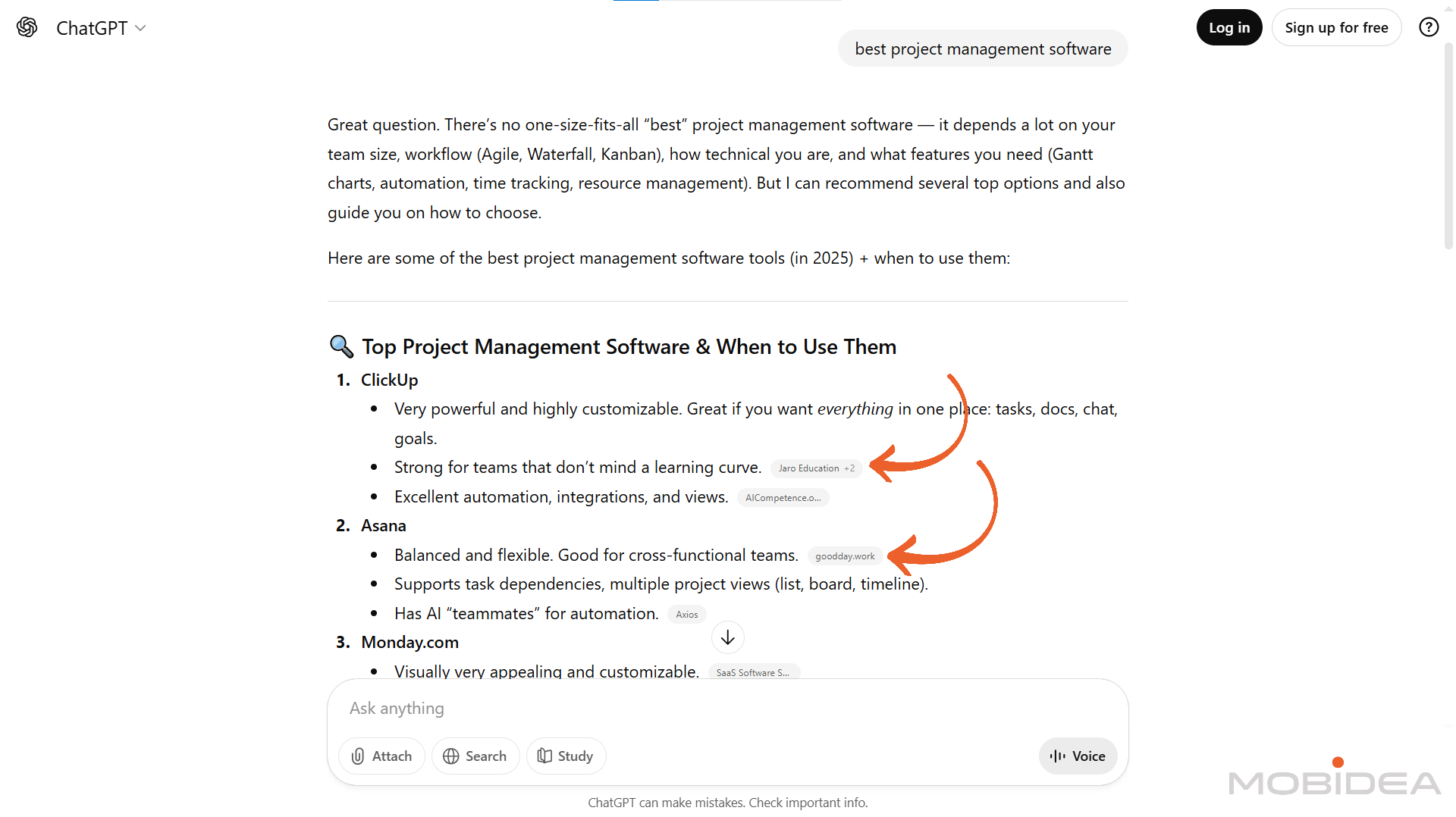
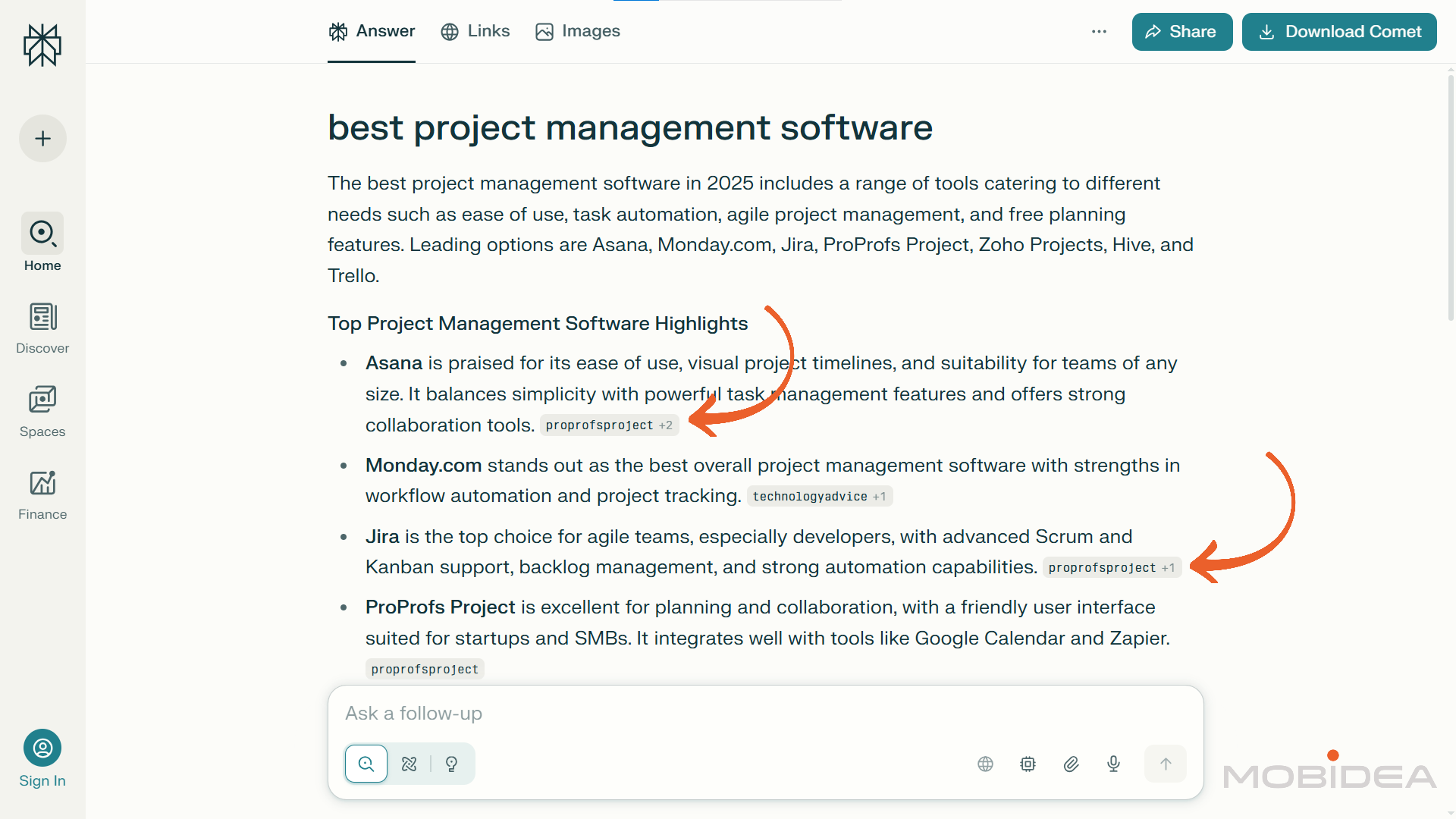
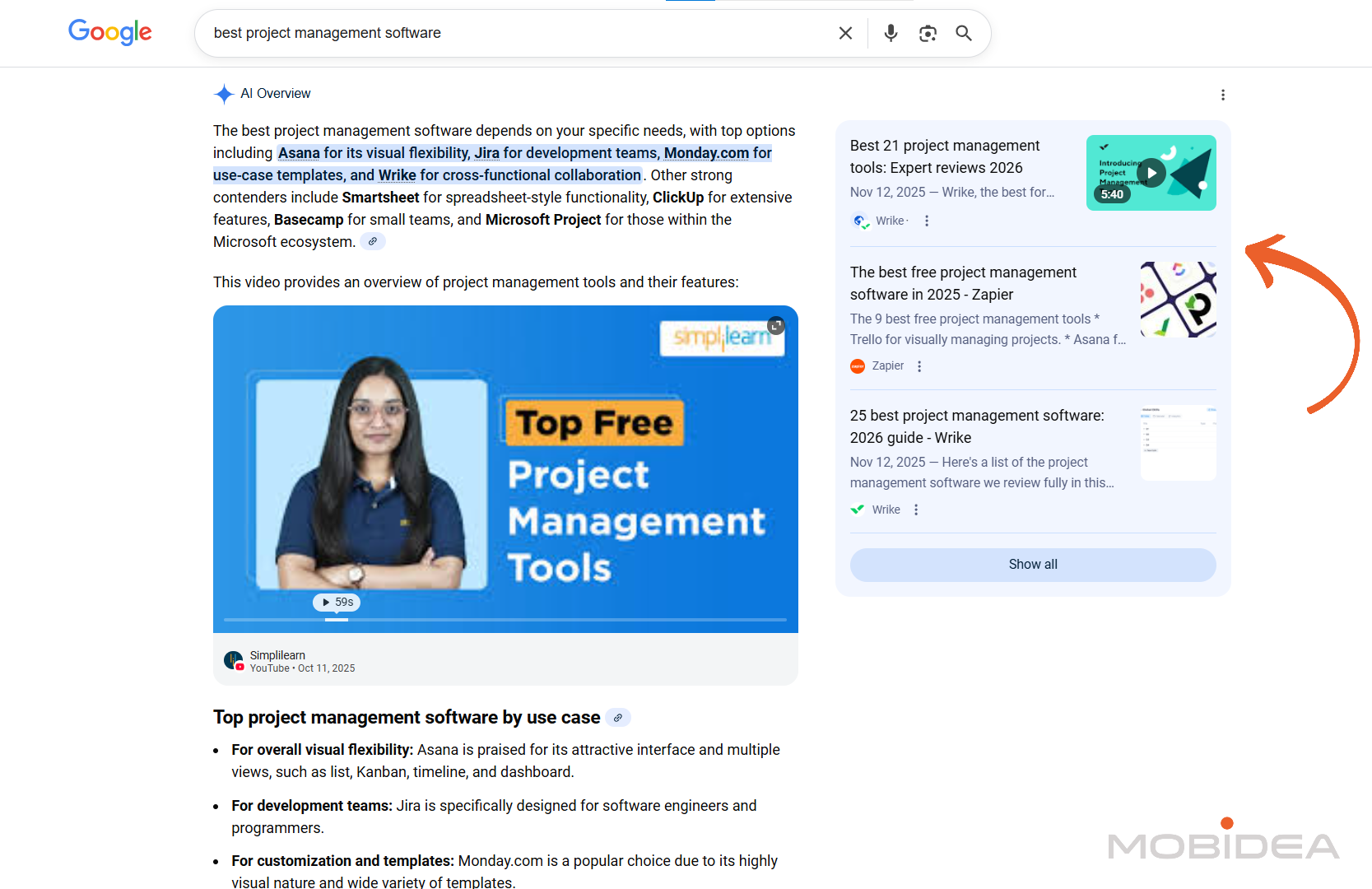
3. Document which sources get cited. Here are examples:
- ChatGPT
- Perplexity
- Google Search AI Overview
4. Repeat weekly.
This method works. However, it can take a long time to do.
Set Up Your Baseline Assessment
Here’s how to create your starting point:
Step 1: Identify Your Core Topics
List the 10-15 topics where you need visibility.
Step 2: Document Current State
Where do you appear in AI responses today?
Step 3: Benchmark Competitors
Who’s getting cited instead of you?
Step 4: Set Measurable Goals
Example: Increase citation frequency by 30% in 90 days.
Step 5: Create an AI Visibility Dashboard
Track these metrics:
- Weekly citation counts by platform
- Share of voice by topic area
- Competitor comparison metrics
- Query coverage percentage
- Month-over-month growth trends
Build Your AI Search Performance Checklist
Create a practical framework for ongoing tracking:
Weekly citation audits across AI platforms:
- Test your top 10 target queries in each platform
- Document which brands get cited
- Note the context and positioning of citations
- Track changes from last week
Competitor citation analysis:
- Who are your top 3 competitors in AI visibility?
- What topics do they dominate?
- How frequently are they cited compared to you?
- What content formats work for them?
Query categories analysis:
- Which question types include your brand?
- Where are you completely absent?
- What new query opportunities exist?
- Are seasonal trends affecting your visibility?
Content gap identification:
- What topics does AI cite but you haven’t covered?
- Where do competitors have content you don’t?
- What user questions go unanswered on your site?
Attribution accuracy monitoring:
- Are citations linking to the right pages?
- Is your brand name spelled correctly?
- Are attributions accurate to your actual content?
This systematic approach turns AI search optimization from guesswork into strategy.
Easy AI Search Results Tracking with Semrush One
If you find manually tracking too labor-intensive and time-consuming, you should use a tool to make everything more efficient. That’s where Semrush One comes in.
This tool can monitor AI search results automatically. Everything you need in one dashboard.
The platform gives you access to over 100 million prompts and covers six regions: United States, United Kingdom, Canada, Australia, India, and Spain.
With Semrush One, you’ll know what’s working, what isn’t, and where to focus next. The platform provides the largest dataset available for AI search visibility.
You can see exactly where your brand appears in AI search results.
What makes Semrush One valuable is that you see the platform in action with real data.
You’re not just reading about features. You see how actual brands use these tools to improve their AI visibility.
The platform covers everything from setting up your first tracking project to making optimization decisions based on data.
Practical Implementation: Building Citation-Ready Content
This section shows you exactly how to use Semrush One to track citations, find opportunities, and measure progress.
Set Up Your First AI Visibility Project
Let’s start with how to use Semrush’s newest tools. It may look complicated at first, but I promise you, the more you use it, the easier it gets.
Step 1: Access the AI Visibility Toolkit
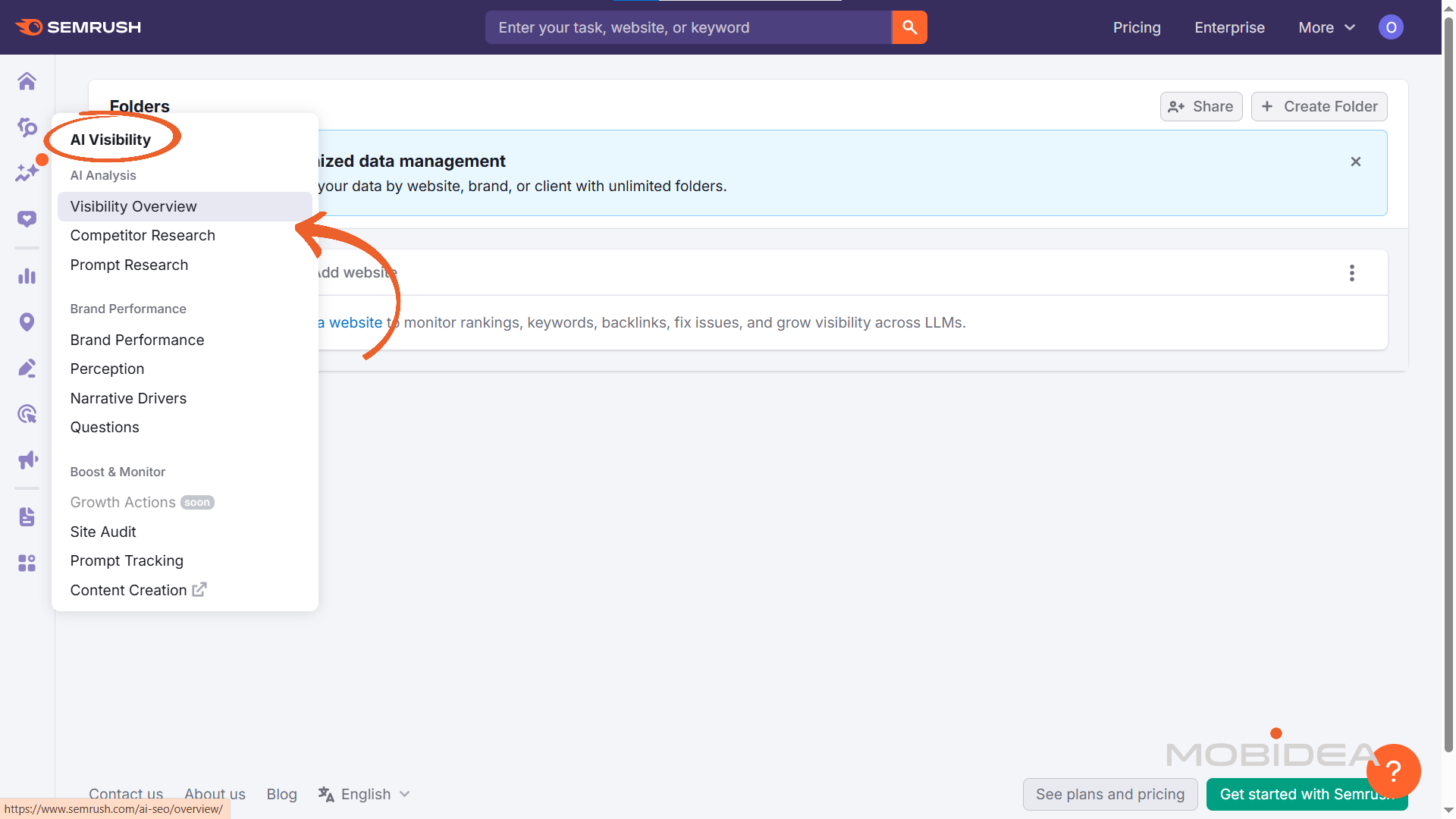
Log in to Semrush One and navigate to the AI Visibility Toolkit.
The AI Visibility Toolkit includes three powerful reports:
- Visibility Overview – Shows your overall AI presence across all platforms and regions
- Prompt Research – Reveals which queries trigger AI citations in your space (this helps you find content opportunities)
- Competitor Research – Shows exactly where competitors are winning citations that you’re missing
Step 2: Check your AI visibility
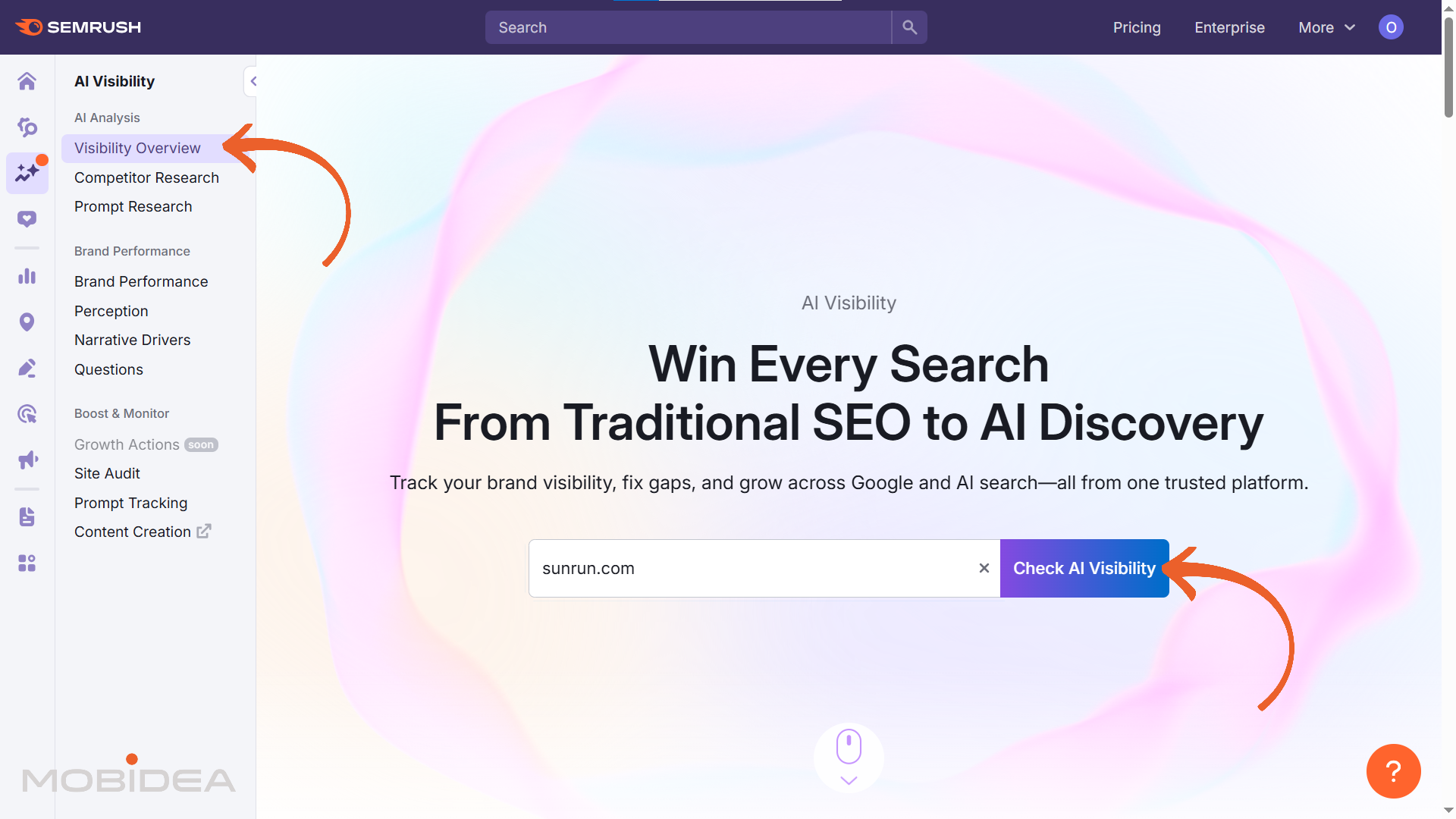
Use Visibility Overview. Enter your domain and click “Check AI Visibility.”
When your data loads, you’ll see your Visibility Overview dashboard. This is your command center for AI search performance.
Step 3: Understand Your Dashboard
Overall visibility score: You’ll see a number that represents how often AI tools cite you in various AI platforms.
Below that, a graph shows your visibility trend over time. Is it going up, down, or staying flat? This tells you if your optimization efforts work.
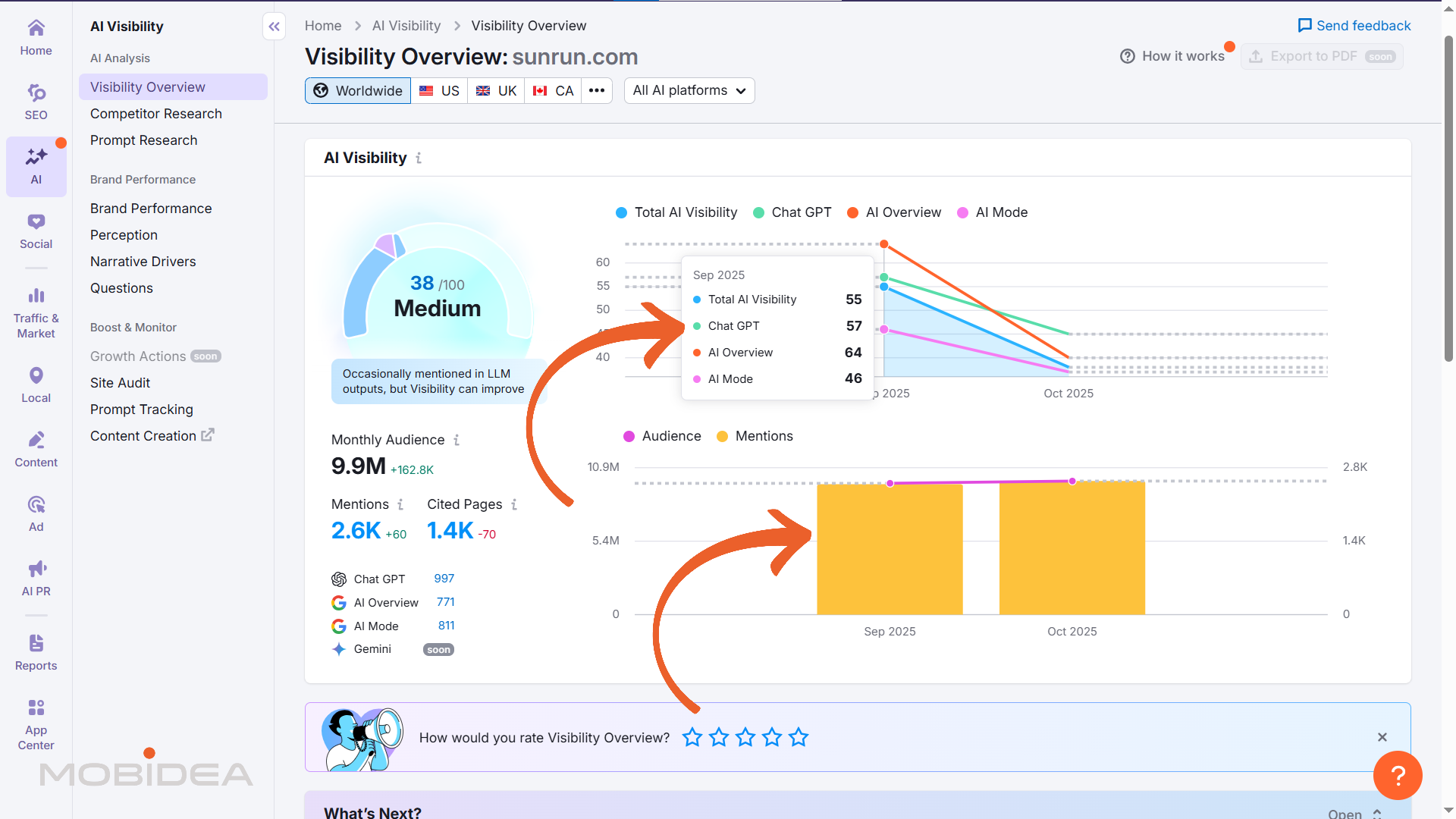
Platform-specific data: Check the separate metrics for ChatGPT, Google AI Overview, and AI Mode. Gemini data will soon be included.
This breakdown matters because each platform has different citation patterns. You might dominate in ChatGPT but barely appear in AI Mode.
Knowing where you’re strong and weak guides your optimization priorities.
Drill into details: Click on any platform to go deeper.
You’ll see which specific queries trigger citations to your site. These are your winning topics—the content that’s already working.
Study these queries. What do they have in common? What content format are they pulling from? This reveals your citation recipe.
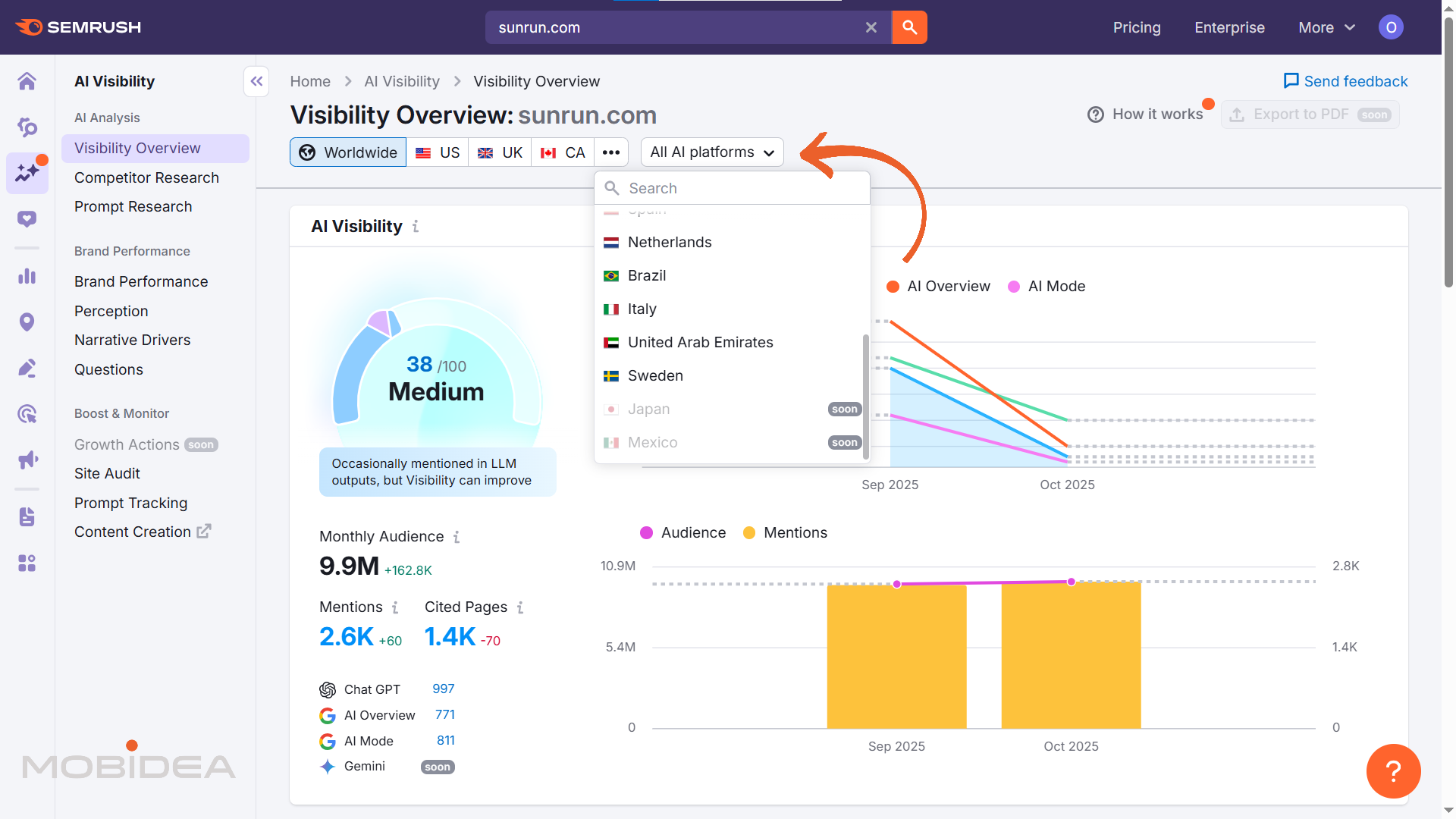
View available regions: You can select your target region from those currently available.
Semrush keeps on adding new regions. For now, let’s stay with Worldwide.
Hovering over the score will give you more info on the performance per country. The highest possible score is 100.
The purple arrow shows industry averages. In our sample below, you’ll notice that the website we’re checking is showing a score that is higher than the industry average.
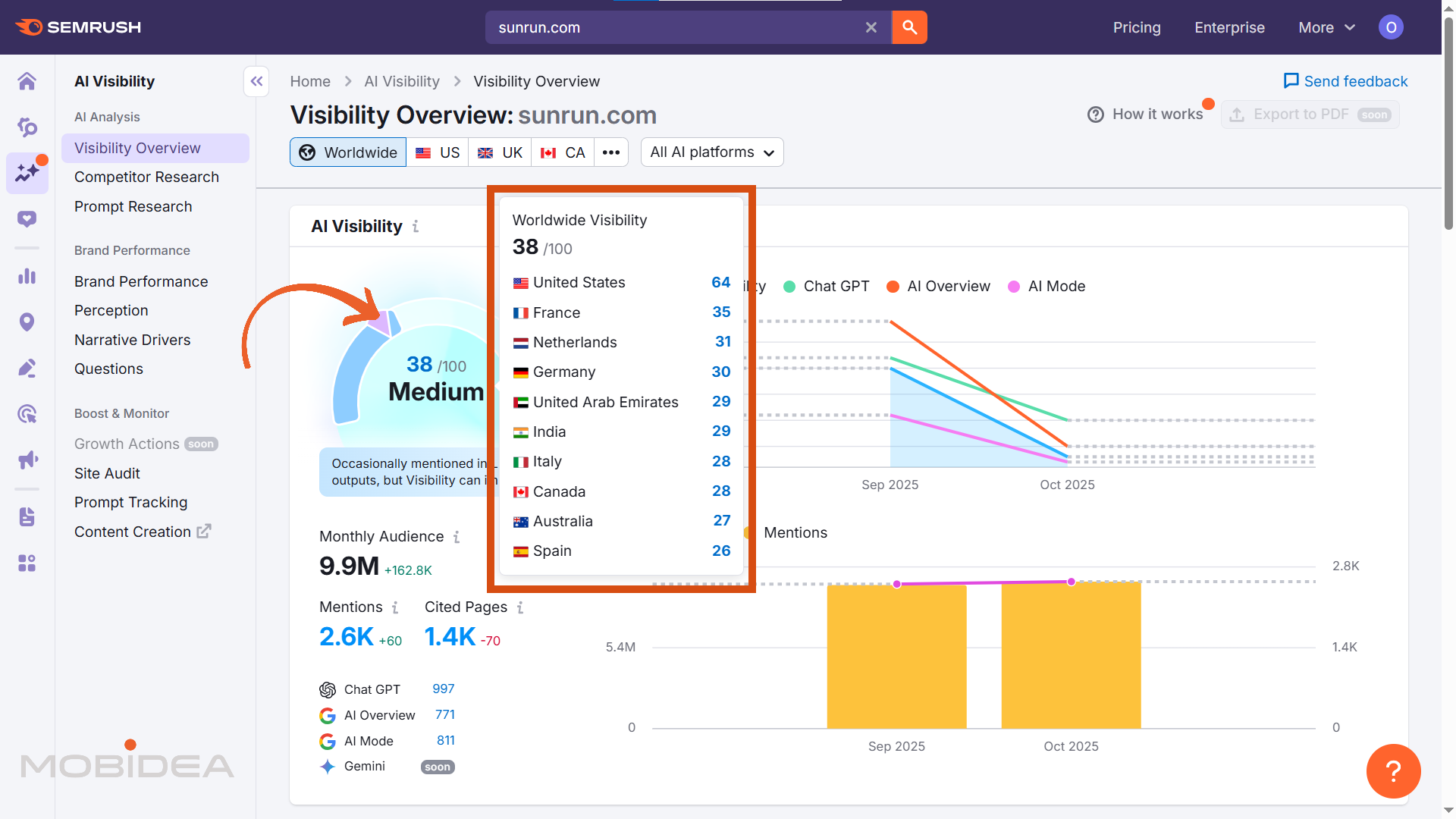
You can click on the country scores to see the overview per location.
Step 4: View Topics & Sources
Scroll down the page and check the Topics and Sources section.
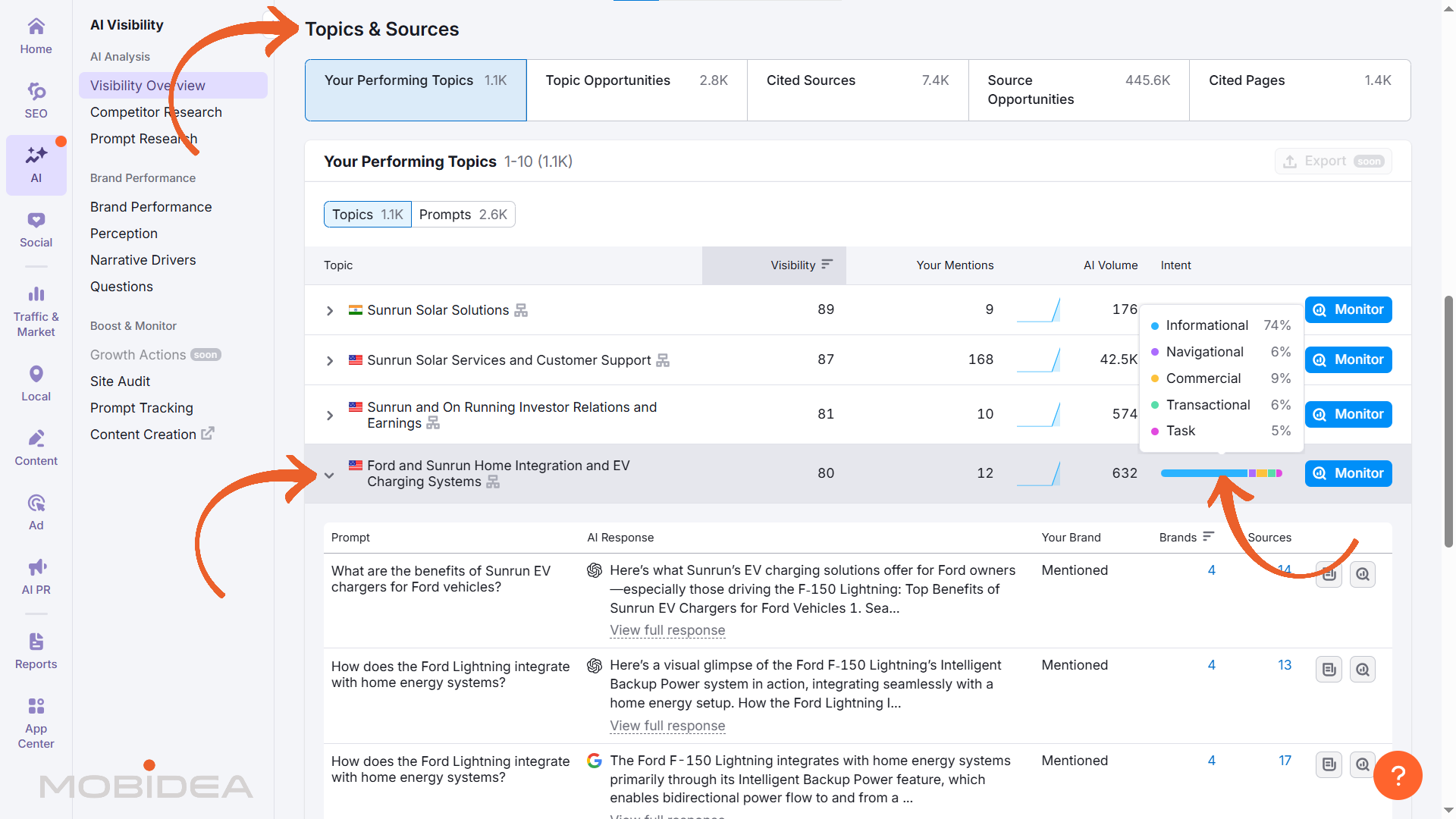
Under “Your Performing Topics”, you can see which of your topics are being mentioned in AI searches.
Data being shown is your AI visibility score for that topic, mentions, AI volume, Intent (Informational, Navigational, Commercial, Transactional, and Task).
Clicking the drop arrow next to the topic reveals the prompts and AI responses.
Step 5: Check Topic Opportunities
What topics are you missing that you can explore? Check these through the Topic Opportunities tab.
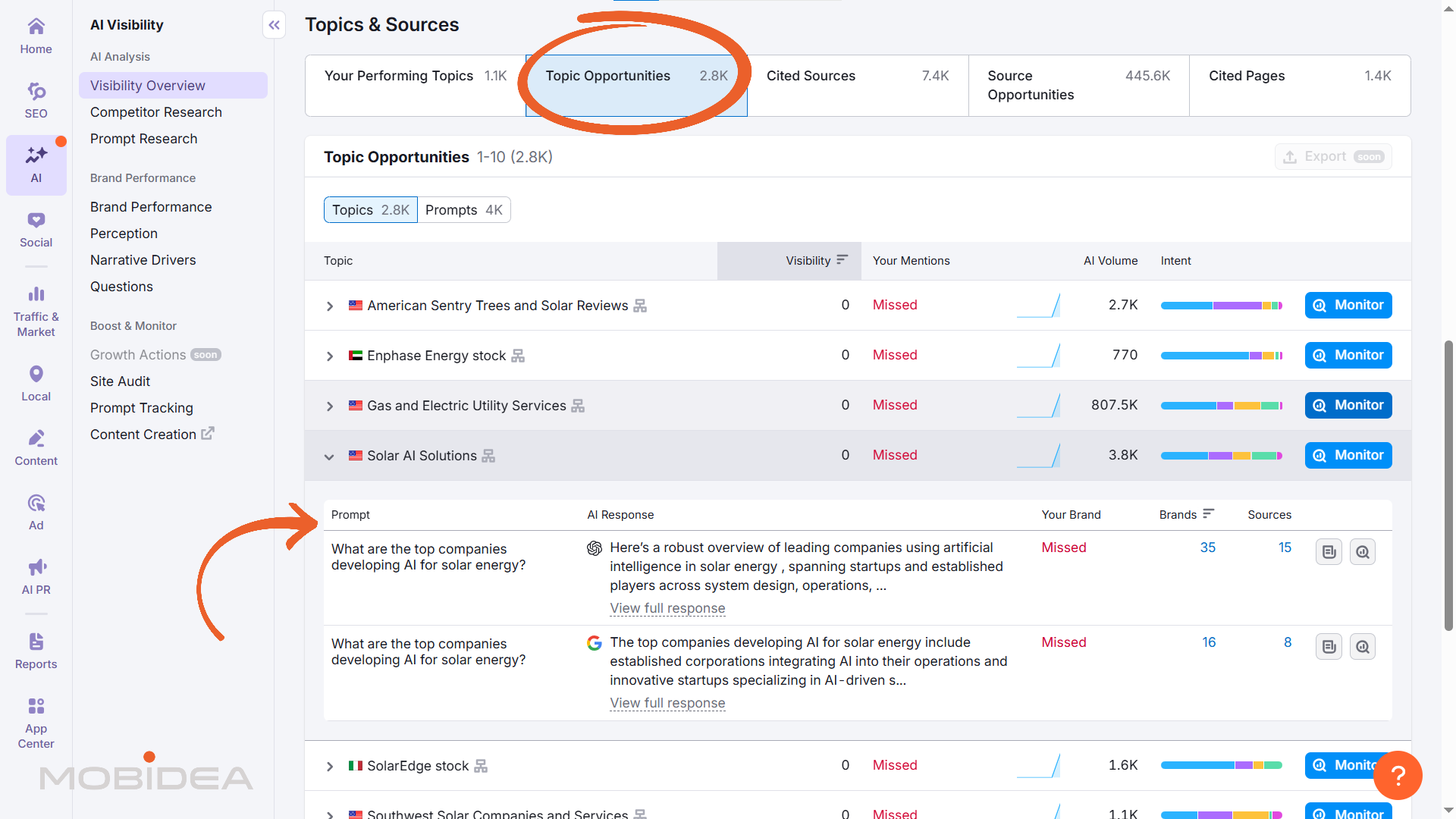
Identify content gaps: Look at topics where competitors appear but you don’t.
These are your content gaps. Write down the top five gaps. These become your content priorities for the next 30 days.
Competitor Research: Learn from Winners
Head to Competitor Research. This report shows exactly where your competitors win citations that you’re missing.
It’s competitive intelligence for the AI search era.
Step 1: Select Top Competitors
Semrush One will have chosen what it believes are your best competitors.
Still, you can edit these. Pick three to five competitors who target the same audience and topics.
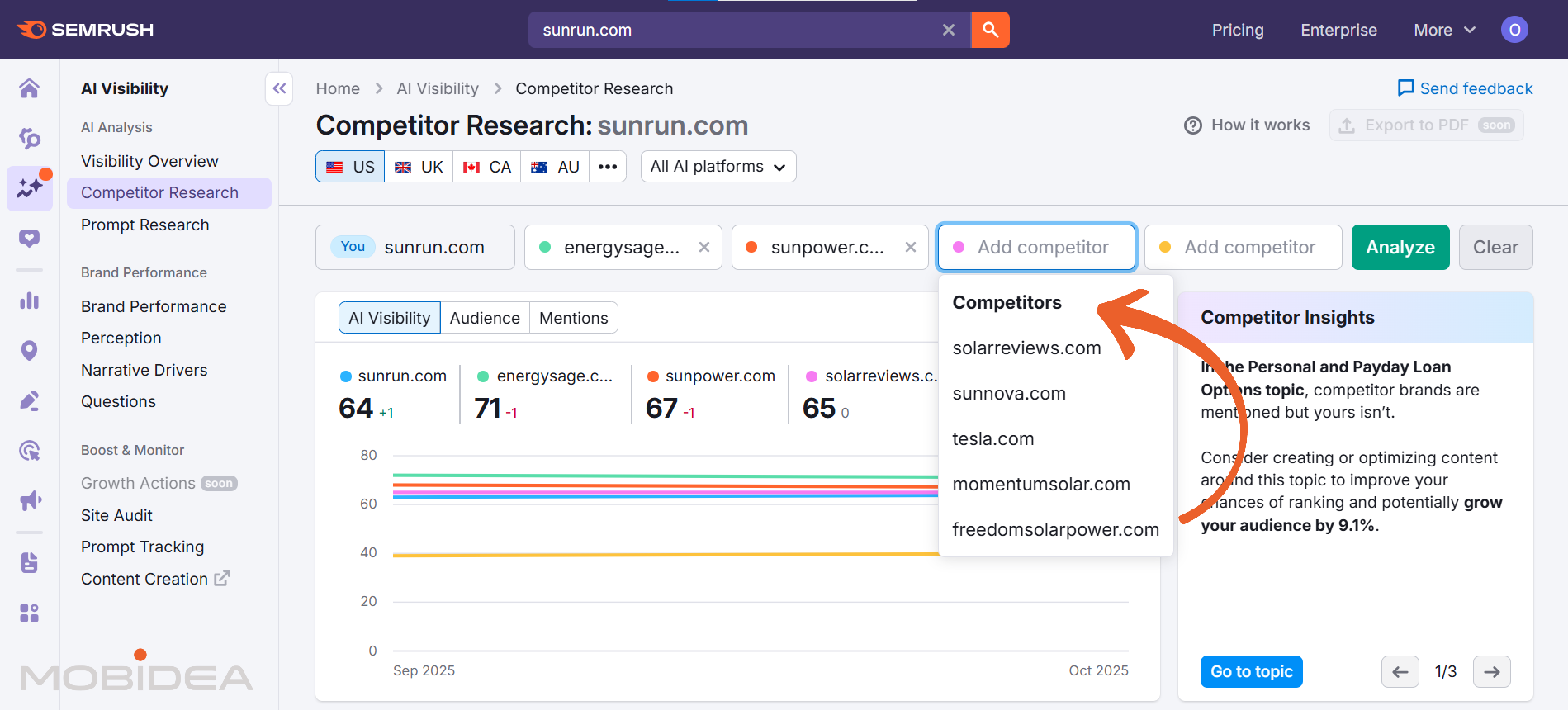
This gives you benchmarks to measure against. You’re not just tracking your visibility—you’re understanding the competitive landscape.
Step 2: View Comparison Chart
The main chart shows your visibility versus competitors based on AI visibility scores.
You’ll also see the Competitor Insights. This card will provide you with recommendations based on you and your competitors’ performance.
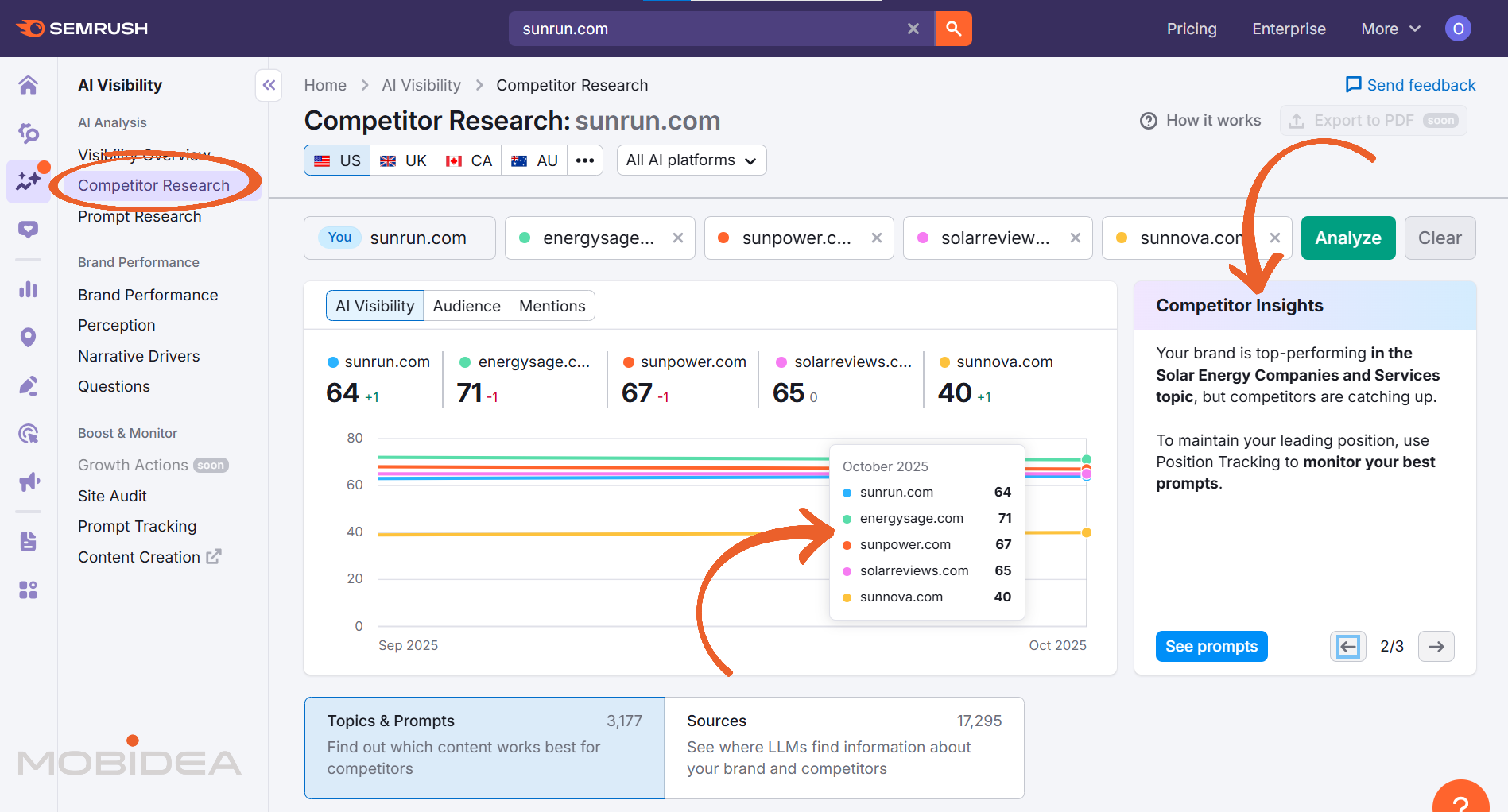
Note that there is no Worldwide option here. It’s all country-specific.
Step 3: Deep-Dive into Competitors
Scroll down to the Topics & Prompts section.
Click on a competitor to see their top-cited content first.
Click on the dropdown arrow next to the topic to see which prompts. This is valuable intelligence.
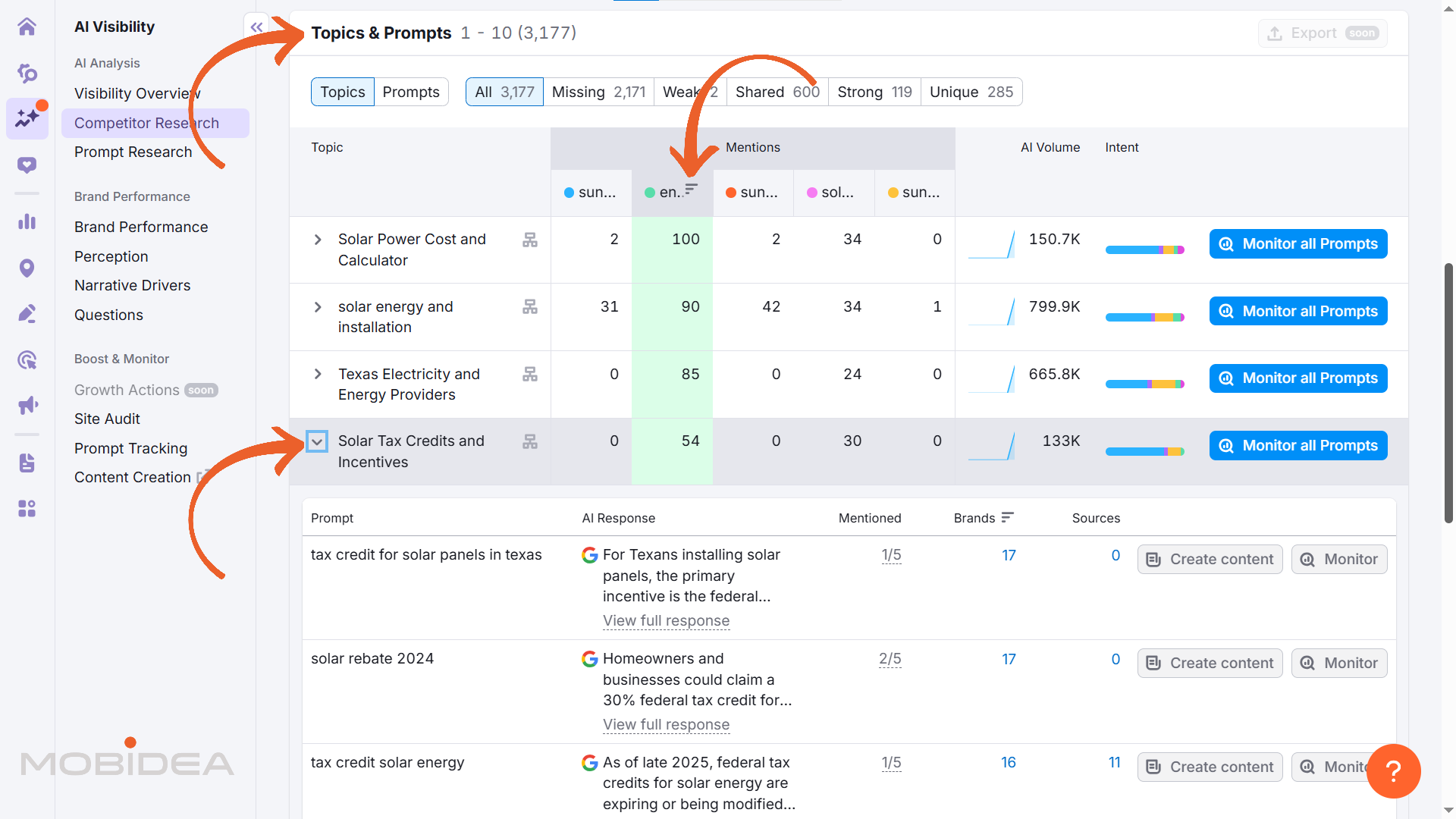
You can also select the Missing tab to find topics and prompts where your competitors are mentioned and you are being left out.
Again, these are opportunities you can exploit.
Step 4: View Sources
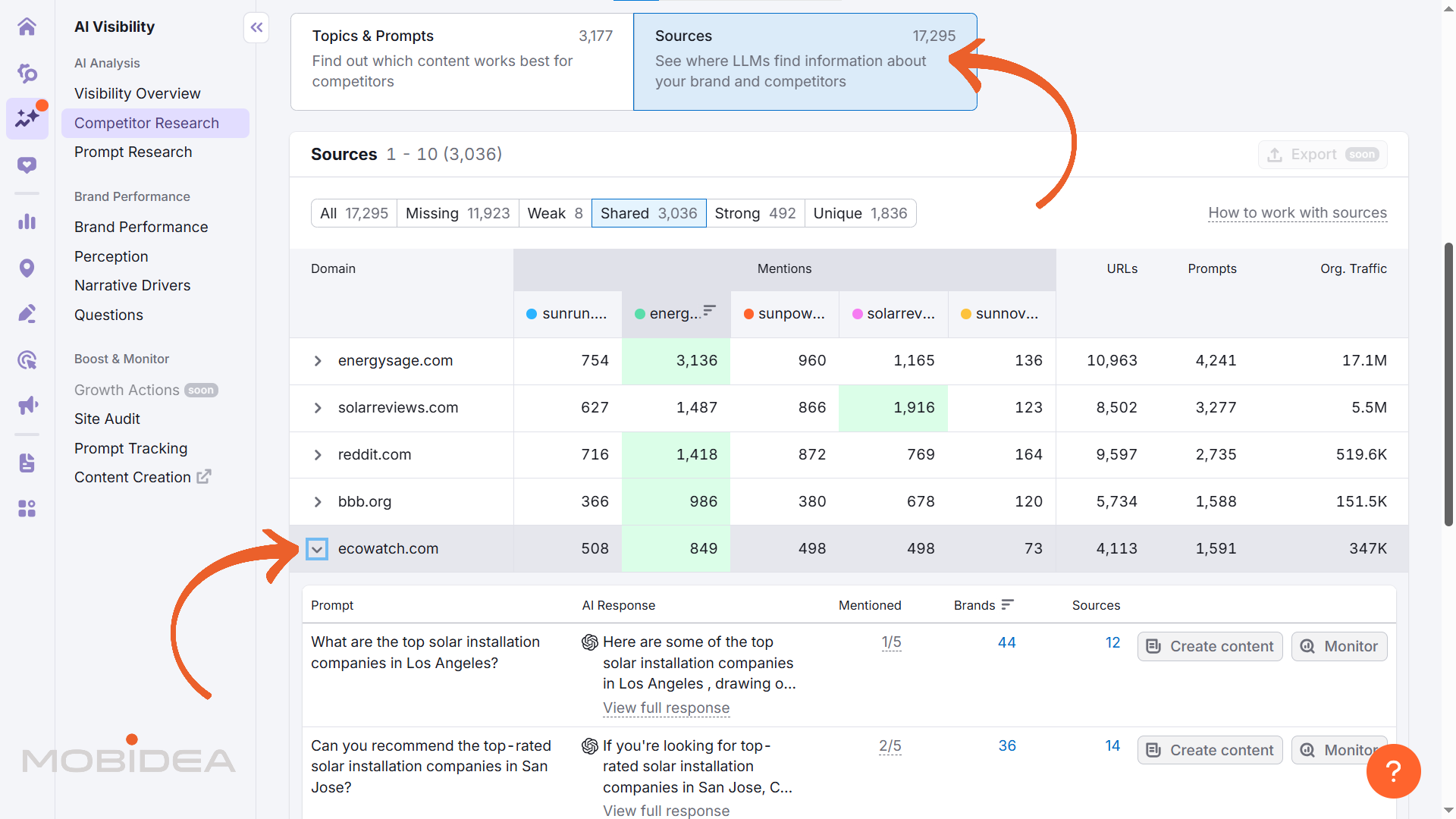
The sources are the websites that LLMs rely on or scan to include you in their citations.
If you want to be mentioned more often for specific topics, find a way to get featured more often (or discussed more deeply) in these sources.
Click on the website to view the prompts and AI responses.
Tip: Look for patterns. Don’t just copy what competitors do.
Look for patterns across multiple competitors. If three different competitors all get cited for FAQ content about a specific topic, that’s a pattern worth following.
If only one competitor does something unique, it might be their specific advantage rather than a universal best practice.
Step 5: Filter by Platform
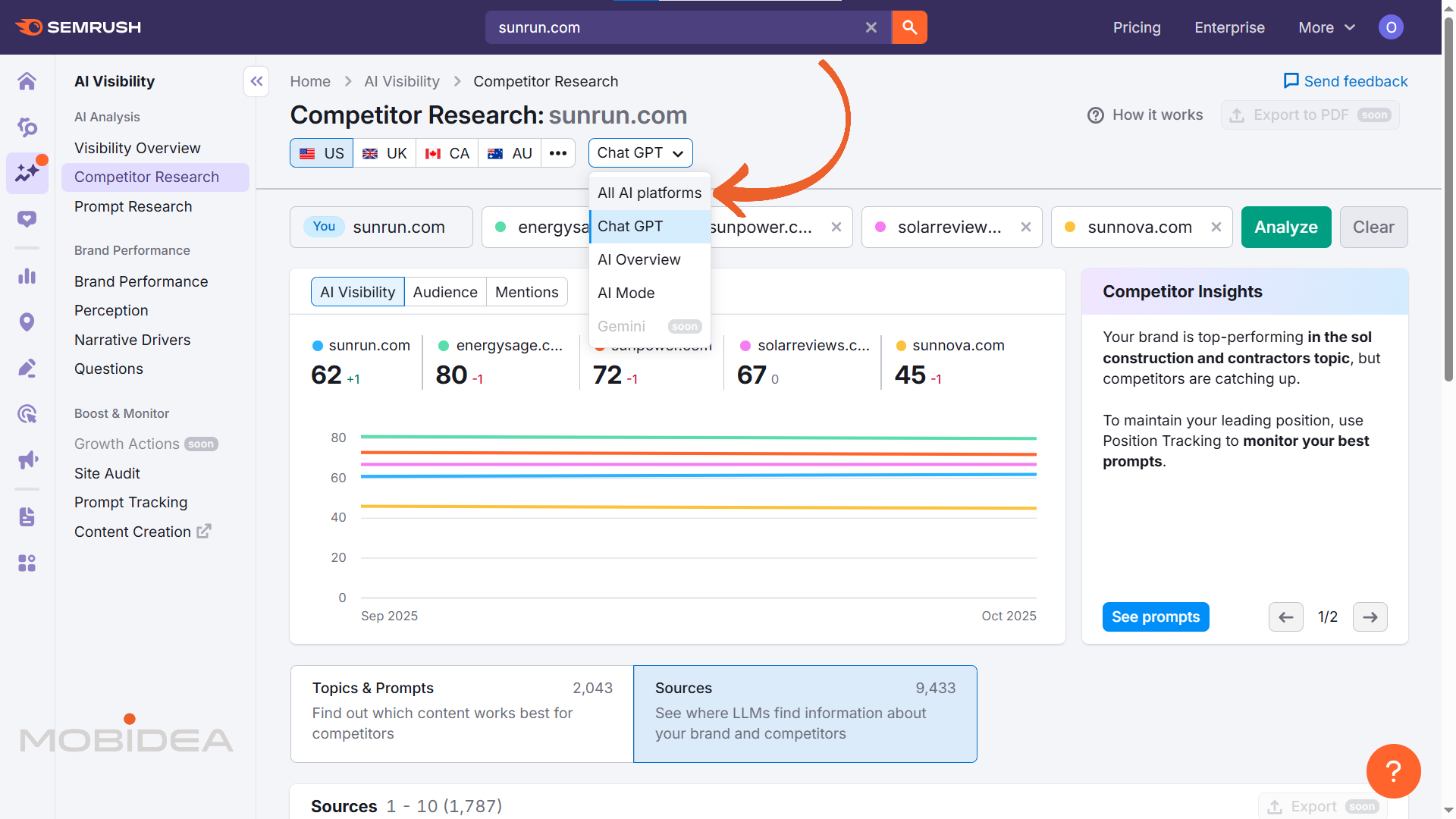
Use the LLM filter option at the top to narrow down results based on platform.
See which competitors dominate ChatGPT versus Google AI Mode. Different platforms favor different content styles. This helps you understand why.
Tip: Export your findings. Download all this data to spreadsheets.
Create a competitor citation matrix showing who wins what topics on which platforms.
Look for categories where competitors significantly outperform you. These are opportunities.
Share this with your team. Everyone should understand the competitive landscape.
Prompt Research: Find Citation Opportunities
Click over to Prompt Research.
This is where you discover what people actually ask AI tools in your industry. It’s like keyword research, but for AI search.
Here’s how to use Prompt Research:
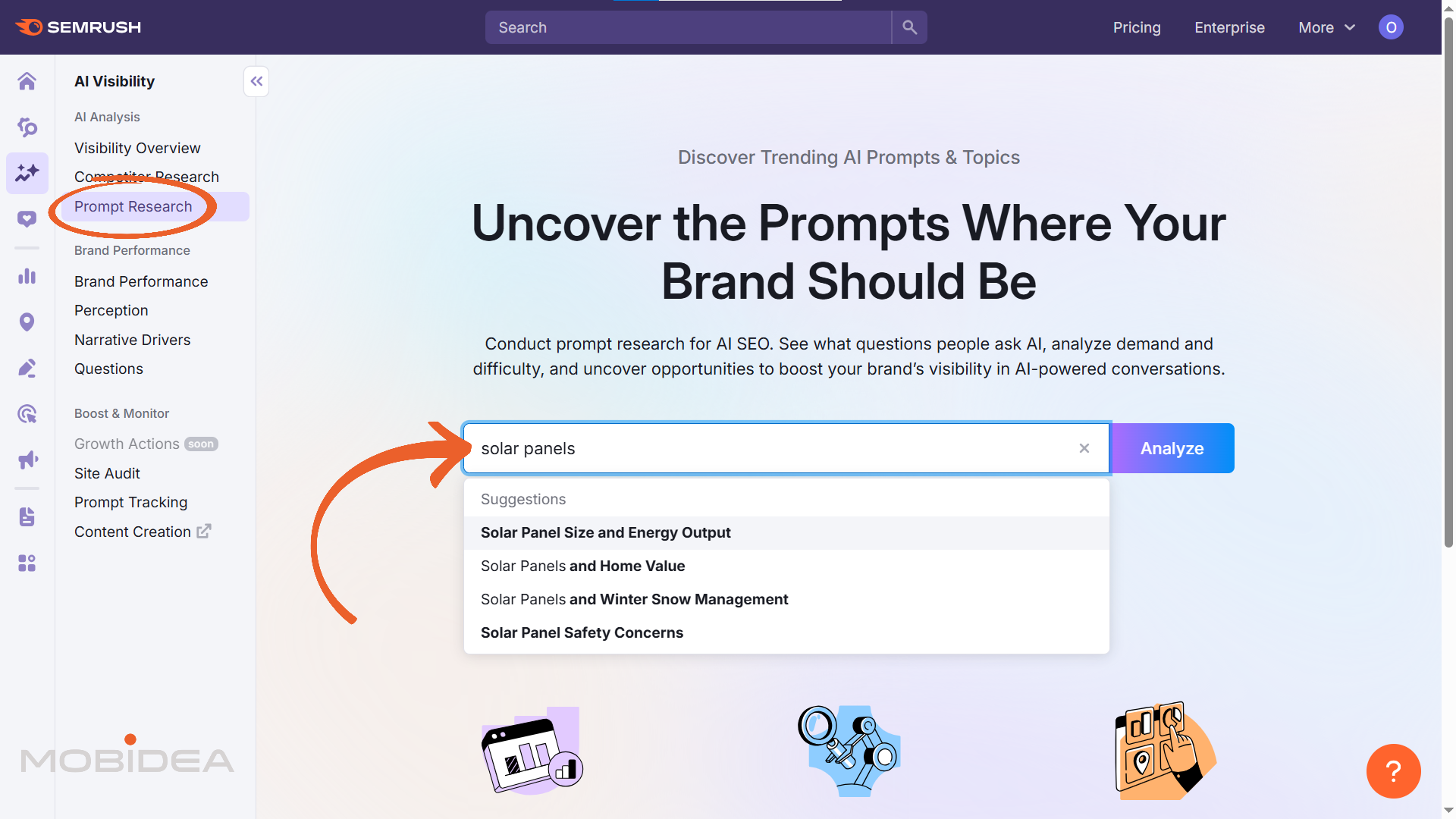
Step 1: Enter A Relevant Topic
Type something like “email marketing” or “solar panels”.
You’ll be shown a list of suggested topics. Choose from these, else you might not get any data.
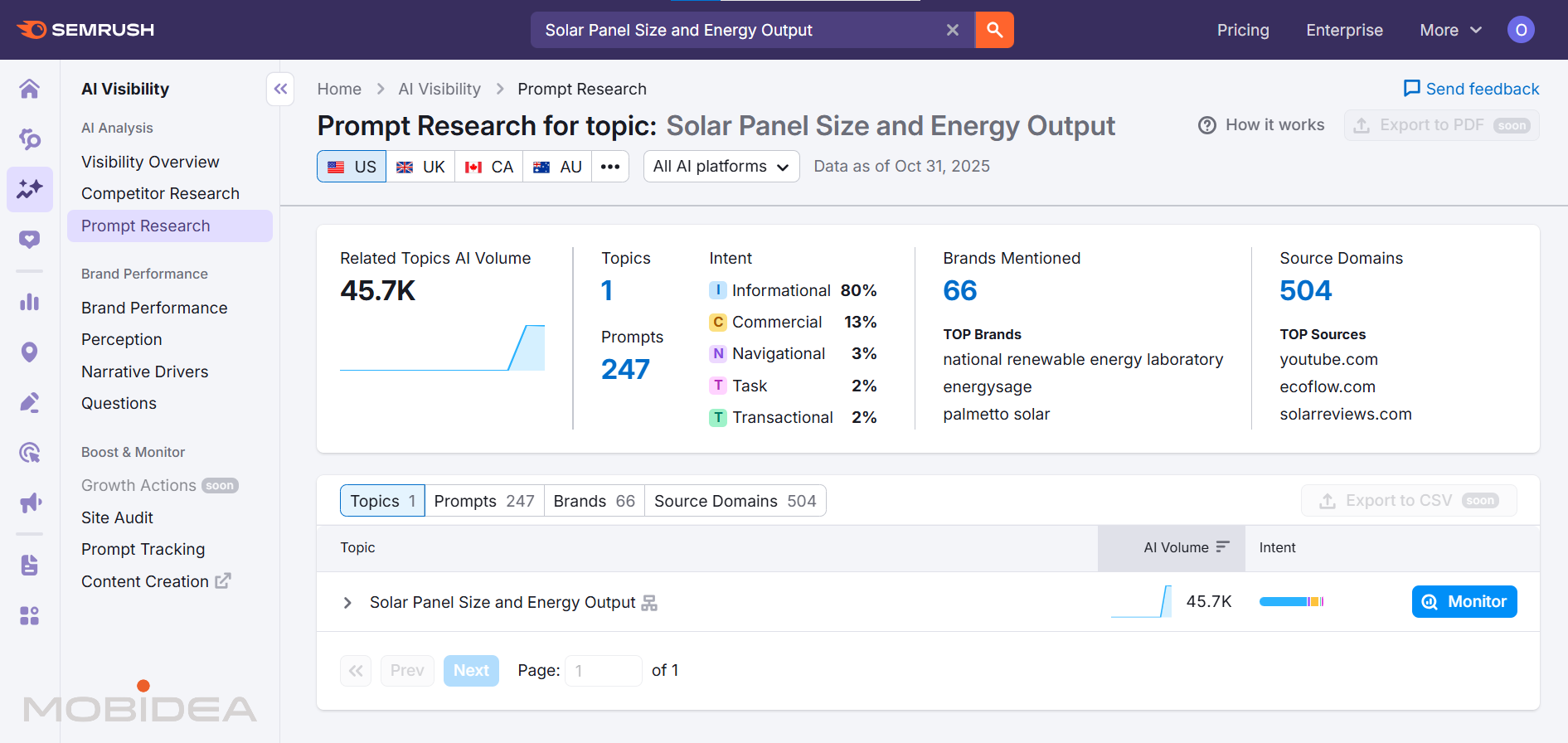
Step 2: Review the Results Overview
Semrush One shows you the most common prompts related to that topic. You’ll see how many times each prompt appears and which brands get cited in responses.
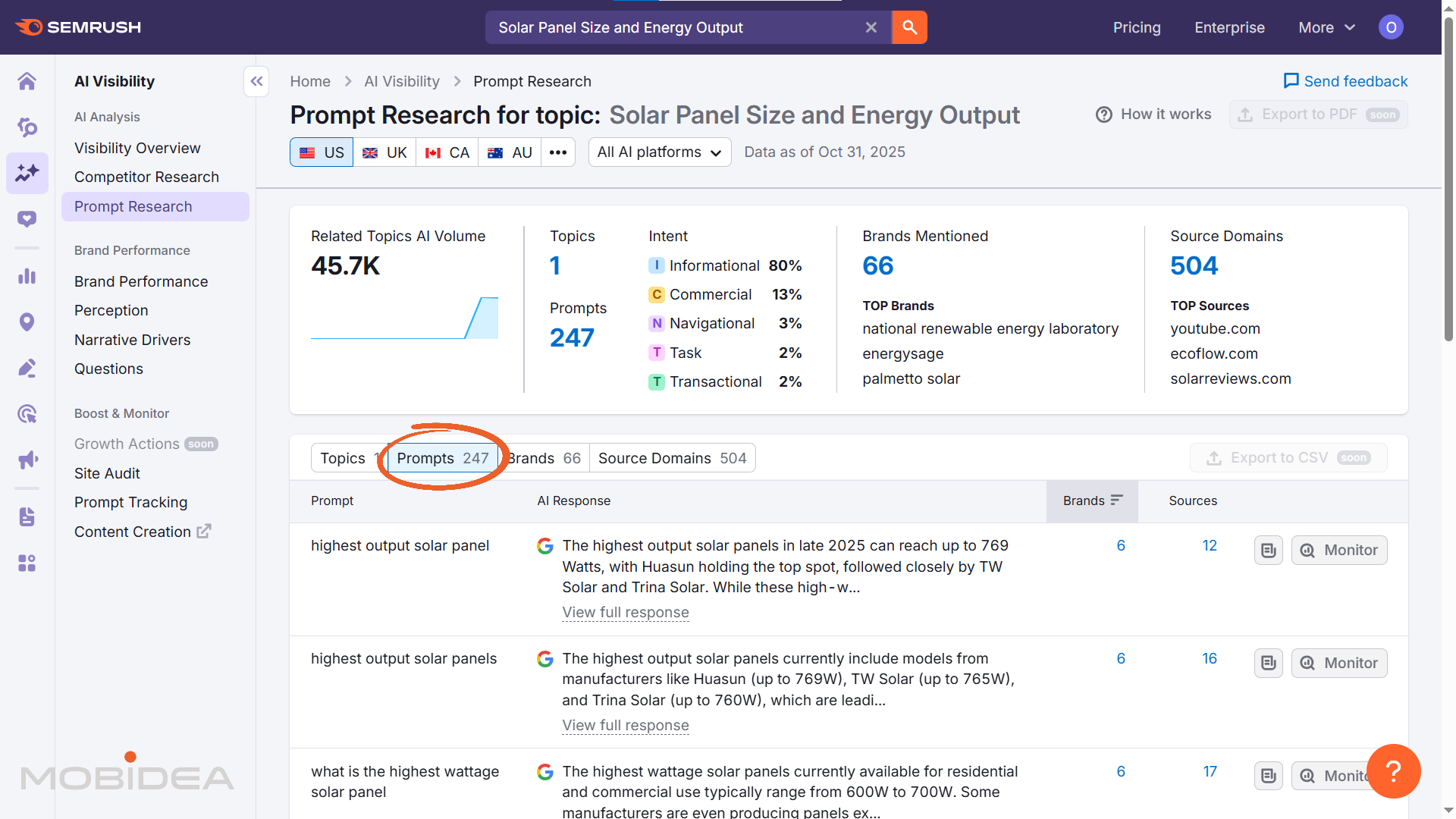
Step 3: View Prompts
Just beneath the Overview, you’ll find a table for more details. Click on Prompts to find those related to your search topic.
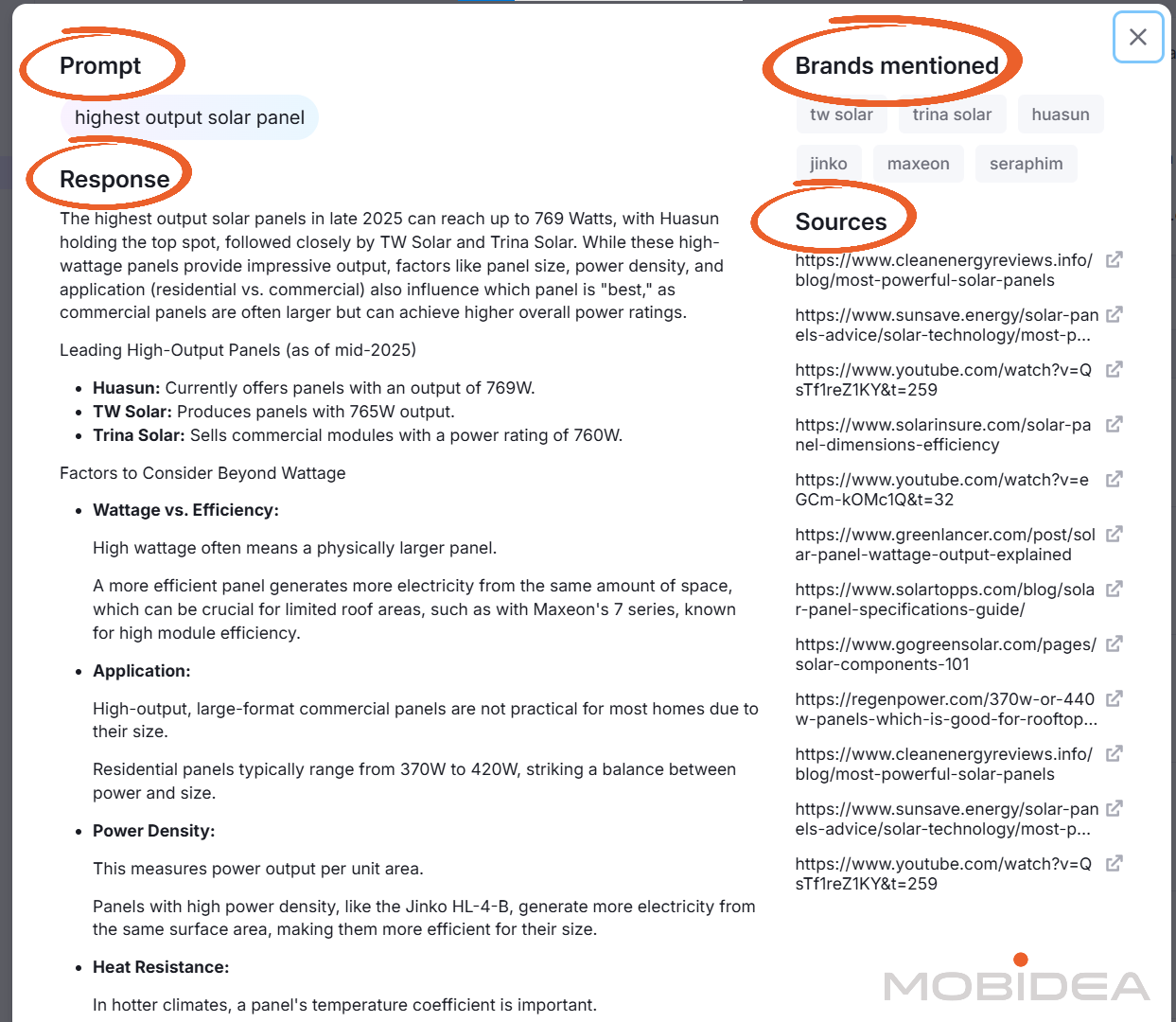
If you click on the number under Brands across your chosen prompt, a window will appear to show you in-depth details, such as the response, brands mentioned, and pages cited.
Step 4: View Brands
This section will show you which brands are being mentioned for your chosen topic. What’s great about this is that it doesn’t just list your top competitors—even those small companies falling under the same category or industry.
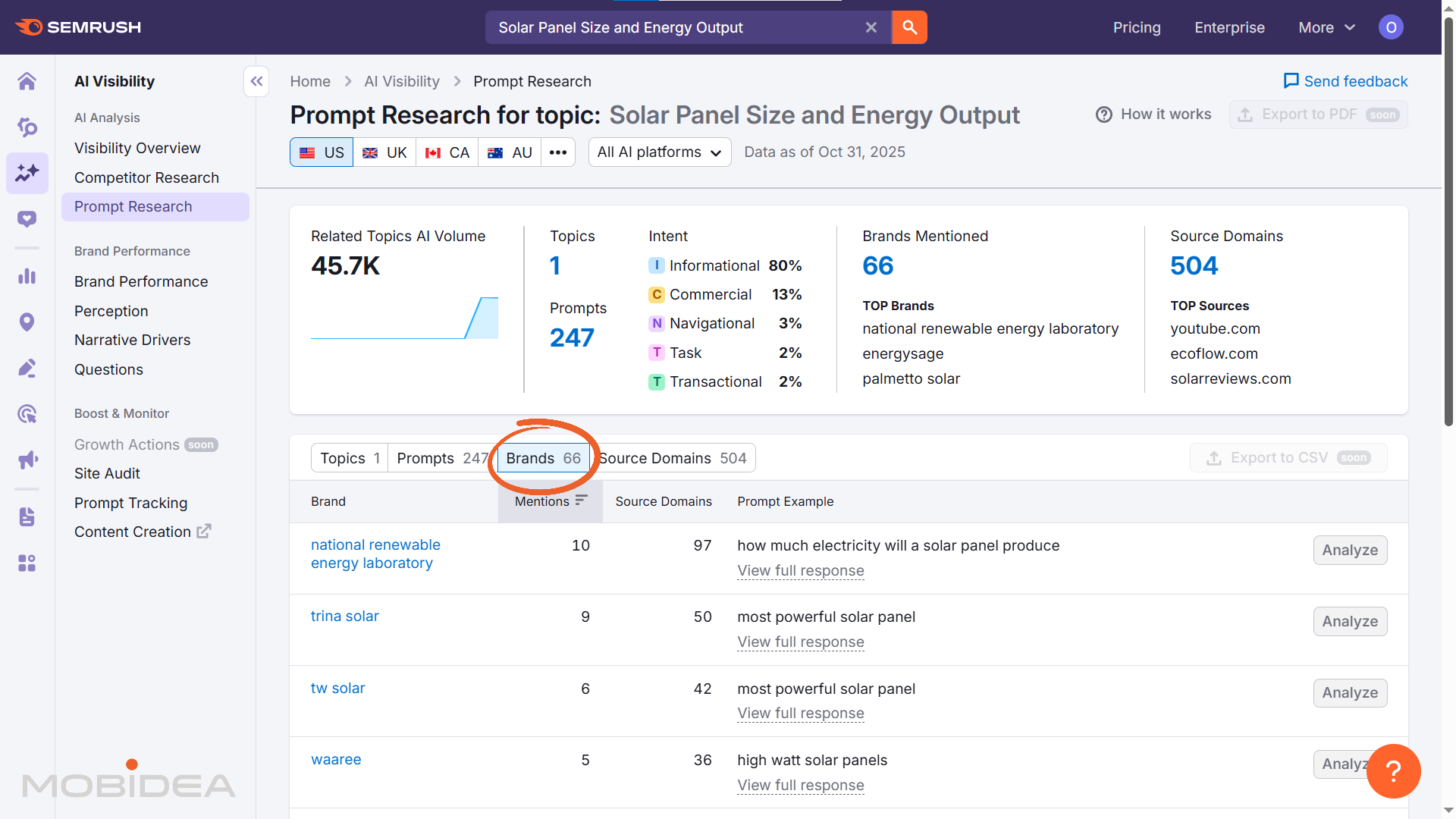
Tips for Using Prompt Research
- Look for opportunities
Find prompts with high volume but low competition.
If lots of people ask a question but only a few brands get cited, you can create optimized content and capture those citations.
- Note the question format
Are people asking “how to” questions? “What is” questions? Comparison questions?
The format tells you what content type to create:
⬜ “How to” questions → Step-by-step guides
⬜ “What is” questions → Clear definitions
⬜ Comparison questions → Side-by-side analysis
- Study winning content
Click on any prompt to see which pages currently get cited. Semrush One shows you the actual content pages that wins citations.
Open those pages in new tabs and study them. What structure do they use? How do they format information? What schema do they have?
You’re reverse-engineering success.
- Create your content plan
Pick five high-opportunity prompts. For each one, note:
-
- Content type needed
- Structure that works
- Schema requirements
This is your roadmap for the next month.
Build Your Weekly Tracking Routine
Create a consistent tracking routine. Every Monday morning, spend 30 minutes in Semrush One reviewing your data.
Your weekly checklist:
1. Check visibility score trend
Is it moving in the right direction? If you’re flat or declining, something needs to change in your content strategy.
2. Review new citations
Which content pieces earned new citations in the past week? What did they do right? Double down on what’s working.
3. Look at citation losses
Did you lose citations on any topics? This might mean competitors published better content or your content became outdated. Flag these for updates.
4. Check competitor movements
Did any competitor make a big jump in visibility? Click into their data to see what they published or changed. Learn from their wins.
5. Update content priorities
Adjust your priorities based on this week’s data. Maybe a new high-value prompt appeared in Prompt Research.
Maybe a competitor gap you didn’t notice before shows up. Stay flexible and data-driven.
The AI Citation Strategy Framework
Now that you understand the landscape and know how to track performance, let’s build your optimization strategy.
This framework gives you a clear path from content creation to AI citations. The three pillars work together to make your content citation-worthy.
If you look back at the core questions by SEOs we have at the beginning of this article, you’ll find that this framework answers them.
The Three Pillars of AI Citations
Traditional SEO focuses on climbing rankings. AI search optimization focuses on earning citations. These goals overlap but aren’t identical. You need a framework that addresses both.
The AI citation strategy breaks down into three core pillars:
- Discoverability – Gets AI to find your content
- Authority – Makes AI trust your content
- Structure – Helps AI understand and accurately cite your content
All three work together. Master these elements, and you’ll transform how AI models see and cite your content.
Pillar 1: Content Chunking for AI Consumption
AI models don’t read content the same way humans do. They parse it, break it down, and extract information in chunks.
Content chunking means organizing your content into clear, separate sections that each cover one main idea.
If your content isn’t structured for this type of processing, you make it harder for AI to cite you.
Here’s how to apply content chunking:
1. Create Clear Topic Boundaries
Each section should cover one main idea. AI models work best when they can identify separate chunks of information.
They struggle with long, wandering paragraphs that mix multiple concepts.
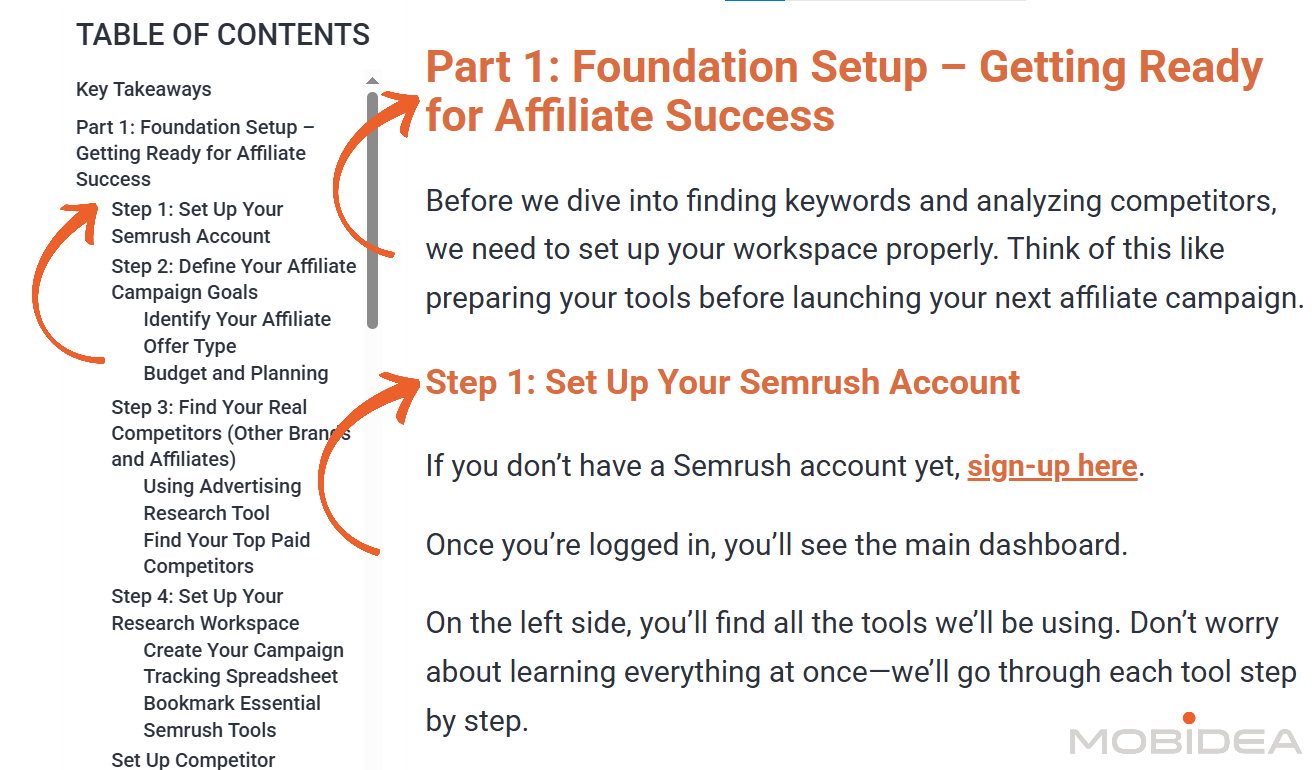
2. Use Descriptive Headers
Break your content into logical sections with clear H2s and H3s.
If you’re writing about email marketing, don’t lump strategy, tools, and metrics into one giant section. Separate them.
Make it easy for AI to find the specific information it needs.
Look at how we do it here at Mobidea Academy:
3. Keep Paragraphs Focused
Aim for 3-5 sentences per paragraph. Each paragraph should contain one main point with supporting details.
Dense walls of text confuse AI models just like they overwhelm human readers.
4. Make Headers Tell A Story
Someone should be able to scan your headers and understand your content structure.
AI models use these headers to navigate your content and determine what to cite. A clear, logical hierarchy makes all the difference.
5. Use Question-Answer Formatting
“What is solar energy?” followed by a clear answer performs better in AI search than burying that definition in paragraph three. This format gives AI exactly what it needs.
6. The “Chunk-First” Approach
Start with the answer, then provide context. State your main point in the first sentence, then explain and elaborate.
AI models scan for direct answers first, so this structure works better.
Pillar 2: Structured Data and Schema That AI Models Understand
Structured data helps AI models parse your content faster and more accurately. Schema is code that you add to your website to help machines understand what your content means.
While traditional SEO uses schema for rich snippets (those enhanced search results with stars and images), AI search optimization uses it for citation clarity.
Not all schemas are equally valuable for AI citations. Focus on schema types that explicitly structure information:
- FAQ schema – Marks questions and answers.
FAQ schema is extremely valuable for AI citations. It explicitly marks questions and answers, making it effortless for AI to extract and cite your content.
If you have FAQ content without schema, add it immediately.
- HowTo schema – Shows step-by-step instructions.
HowTo schema gives AI models a clear roadmap.
They can cite specific steps, understand the process flow, and attribute your content accurately. This is especially valuable for tutorial and instructional content.
- Article schema – Identifies articles and their details.
Include author information, publication date, and headline in your Article schema.
AI models use these signals to assess authority and recency—two factors that influence citation decisions. Complete schema tells AI exactly what your content is and who created it.
- Specialized schemas – Industry-specific markup for your field.
Mark up people, organizations, places, and concepts in your content through entity markup.
This helps AI models understand relationships and context. Better context leads to more accurate citations. When AI sees structured entities, it makes better decisions about when to cite your content.
Tip: Use JSON-LD format. JSON-LD is a way to implement structured data.
It’s the cleanest method and the format most AI models can parse easily. Start with FAQ and Article schema, then expand to other relevant types based on your content.
Pillar 3: Quality Signals AI Models Actually Use
AI models evaluate content quality differently than traditional search algorithms. Understanding these signals helps you create citation-worthy content.
- E-E-A-T still matters: E-E-A-T stands for Experience, Expertise, Authoritativeness, and Trust.
These factors matter in AI citations just like they matter in Google rankings. But AI models look for explicit signals: author credentials, cited sources, verifiable data, and clear attribution.
- Be specific and factual: Content that gets cited is specific, factual, and well-sourced.
Vague generalizations don’t make the cut. AI models favor content that makes clear claims backed by data or expert opinion.
- Cite your sources: Cite your data. Reference studies and research.
AI models check these source credibility indicators when deciding which sources to trust and cite. Your references become part of your authority signal.
- Accuracy is critical: Accuracy matters more in AI search than traditional search.
One factual error can disqualify your content from citations.
AI models cross-reference information and favor sources that consistently prove accurate. This is why fact-checking is critical.
- Original research wins: Original research dramatically increases your citation potential.
When you publish unique data or findings, AI models have no choice but to cite you if they want to reference that information.
Original content creates citation opportunities that competitors can’t replicate.
- Show author credentials: Display author credentials prominently.
Author bios, published works, and expertise indicators help AI models assess whether to trust your content.
A recognized expert gets cited more than an anonymous writer. Make expertise visible and verifiable.
- Keep content fresh: AI models favor recent content, especially for topics that change quickly.
Regular updates signal that your information stays current and accurate. Recency tells AI your content reflects the latest information.
Balance Traditional SEO with AI Optimization
You don’t need to choose between traditional SEO and AI search optimization. The best approach uses both, which is why Semrush has combined its SEO tools with their AI Search tools into Semrush One.
They recognize that improving your AI Search visibility goes hand-in-hand with improving your SEO performance.
What to do:
- Keep doing what works: Keyword research, link building, technical SEO, and user experience still drive results.
Your traditional SEO foundation supports your AI visibility. Don’t abandon these fundamentals—build on them.
- Add the three pillars: Chunk your content, implement schema, and strengthen quality signals.
These improvements often boost traditional SEO performance too. AI optimization and traditional optimization work together.
- Remember the overlap: Quality content, clear structure, and authoritative sources benefit both traditional and AI search.
Fast-loading pages, mobile optimization, and good user experience still matter a lot!
- When priorities differ: Traditional SEO might optimize for keywords and backlinks first.
AI search optimization prioritizes clarity, structure, and factual accuracy.
When they diverge, optimize for humans first, then refine for AI consumption. Both traditional search and AI models reward content that truly serves users.
Start Building Your AI Citation Strategy Today
AI-powered results are reshaping how people discover information. The shift to AI citations isn’t happening someday—it’s happening now.
You’ve seen the framework: content chunking for discoverability, structured data for clarity, and quality signals for authority. These three pillars work together to transform how AI models find, trust, and cite your content.
The uncertainty around AI search optimization ends when you commit to a data-driven strategy.
Semrush One gives you actionable insights backed by the largest dataset available.
Track your citations across platforms. Implement the optimization checklist. Test what works and refine your approach based on real results, not guesses.
SEOs who adapt now will own visibility in the next evolution of search.
The citation equity (the value and authority you build from being cited) you build today compounds over time. Each citation creates advantages that grow stronger with every mention.
AI search isn’t replacing traditional SEO—it’s expanding where visibility is won.
Don’t just rank. Be cited.
Start with Semrush One’s free trial and win visibility across all platforms.


Discover the top SEO trends for 2025 and learn how to boost rankings with AI tools, better UX, and local SEO. Stay ahead with practical tips and Semrush insights.

Looking for a complete and trustworthy SEO tool? Read our in-depth SEMrush review and understand how to skyrocket your business to the top.
Local businesses are crushing competitors using Semrush Local Toolkit's free tools. Change the game with these top 5!