mVAS Offer Conversion Flows 101: How Affiliates Get Paid
Last updated on September 22, 2026 8 min read
By now, you should already know the mVAS basics—what it is and why it pays to promote it now.
You’ve probably also gone through the different mVAS offer categories and picked a niche or two that fits your traffic and your audience, whether that’s games, dating, sweepstakes, or even AI companion apps.
But there’s one more piece you need before you start running traffic: how the conversion actually happens.
Every mVAS offer runs on a specific conversion flow, which is the exact steps a user takes to go from clicking your link to getting billed (and you getting paid for it!)
The flow you’re dealing with changes your strategies.
It affects how easy it is to get a conversion, how high (or low) the payout is, and how you should be setting up your landing pages.
So in this chapter, we’re breaking down every major mVAS conversion flow so you’ll know exactly what you’re working with before you launch your next campaign.
Direct Billing Conversion Flows
Also known as Direct Carrier Billing or Direct Operator Billing, this is a popular method for mVAS transactions because of its convenience. Its simplicity makes it attractive for both users and service providers.
A key component of Direct Billing is the Mobile Station International Subscriber Directory Number (MSISDN).
This unique identifier corresponds to the user’s mobile number and SIM card, so the carrier knows who to charge and how.
When a user initiates a transaction, the operator detects the MSISDN to identify and authenticate the user.
The carrier can then automatically charge the user once the user confirms.
For this to work, the following are necessary:
- Internet Connection: The user must be connected to the internet.
- Carrier Data Connection: The user has to be using their carrier’s data network (2G, 3G, 4G, 5G, or LTE), not Wi-Fi or any other internet connection.
The click flow in Direct Billing can vary, but three common types are:
One-Click Flow
In 1-Click flow, the user completes the subscription with a single click on the webpage.
This is the simplest and fastest method.
This method is highly effective in reducing friction and improving conversion rates because it minimizes the steps required for the user to complete the transaction.
Think of it like a Single Opt-In flow in lead gen offers, except it counts only the clicks on the webpage.
Here’s an offer with a 1-Click Flow offer:
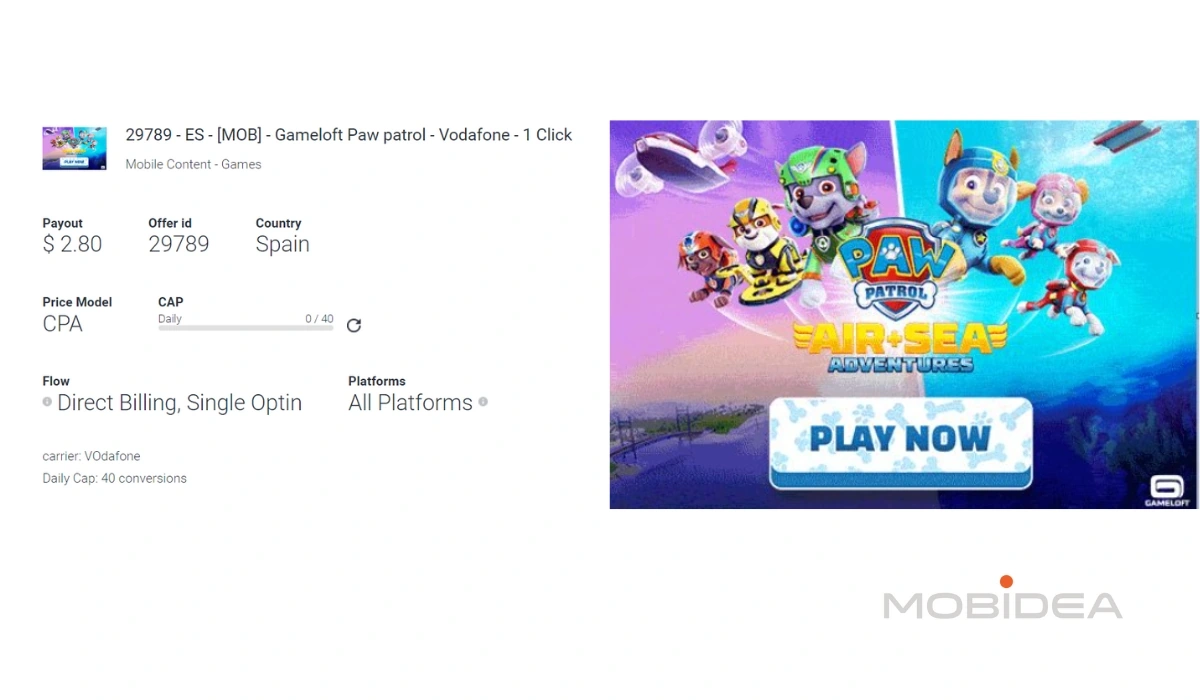
Example: A user visits a mobile game’s landing page and finds a “Subscribe Now” button.
By clicking this button, they automatically subscribe to the service, and the charge appears on their next mobile bill.
However, because clicking accidentally or without actually thinking about it is too common, the conversion quality is not that good.
Also, the payout rates are on the low side.
Right now, many 1Click offers would require manual input of the user’s number to avoid paying for accidental conversions.
It’s among the favorites of affiliates because of its relative ease of getting conversions.
Two-Click Flow
In 2-Click flow, there are two distinct clicks required from the user.
This is slightly more secure as it involves an additional confirmation click.
It’s like the DOI of mVAS, but counting only the clicks on the webpage.
Step 1: The user clicks on the “Subscribe” button on the landing page that’s pre-filled with their mobile number.
Step 2: They are redirected to a confirmation page where they must click “Confirm” to complete the subscription and be charged.
Here’s an offer with a 2-Click Flow offer:
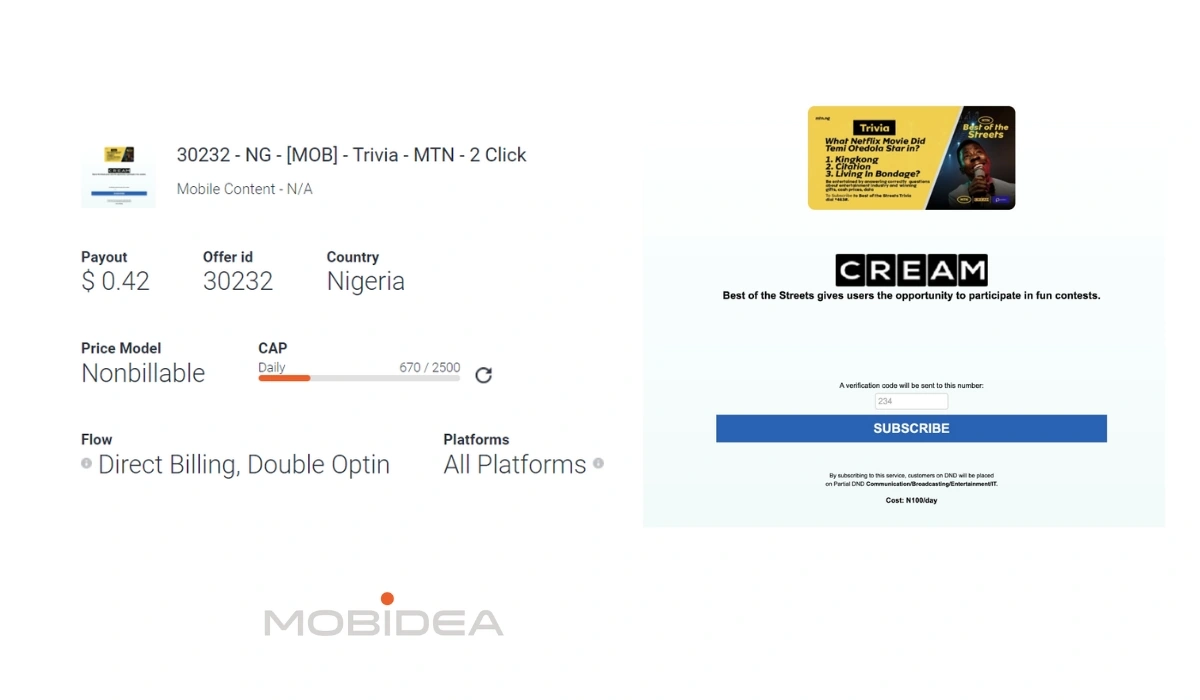
Example: A user interested in a premium video streaming service might click “Subscribe” on the first page.
A new page opens up, so the user confirms their choice on the next page to finalize the subscription.
This 2-step format increases the quality of the conversion, so the payout is higher than the 1-click flow.
However, conversions aren’t as easy to get, so warming your traffic is necessary.
Three-Click Flow
In a 3-Click flow, users must complete three distinct actions to subscribe to the service.
This method is quickly gaining traction nowadays as it solves the issue of low-quality leads that the first two click flow types deliver.
Step 1: The user clicks on the “Subscribe” button on the initial landing page, which is pre-filled with their mobile number.
Step 2: They are then directed to a second page where they must click a “Confirm Subscription” button to proceed.
Step 3: Finally, the user is redirected to a third page where they are required to enter a One-Time Password (OTP) sent to their mobile device.
Upon entering the OTP and clicking “Confirm,” the subscription is completed, and the charge is applied.
Sometimes, the steps change.
Some advertisers add a checkbox that says something along the lines of “I understand that clicking Confirm will incur a monthly charge of $X.”
It all depends on how the advertiser wants to increase the quality of the customers who sign up.
Example: A user wants to subscribe to a specialized fitness app.
They start by clicking “Subscribe” on the landing page.
On the next page, they are asked to click on the checkbox stating their understanding of the charge, before being allowed to click on the “Confirm” button.
Header Enrichment with PIN Submit
With the first 3 flows, the user’s phone number may or may not be shown or pre-filled on the page.
It all depends on the advertiser’s offer page.
Here, the HE+Pin flow begins with header enrichment, meaning the page is prefilled with the user’s mobile number.
This way, the user knows their mobile number is being recorded.
Step 1: The user clicks the “Subscribe” button on the first landing page.
Their mobile number is shown and already filled in.
Step 2: The user receives an SMS with a PIN code.
The user enters this PIN on the next page of the offer page, and then clicks “Confirm”.
This process is similar to a 2-Click or 3-Click flow plus PIN submit, depending on the number of clicks the user needs to make.
SMS Billing Conversion Flows
SMS billing involves using text messages to facilitate mVAS transactions.
It’s a user-friendly approach, capitalizing on the popularity of SMS for easy text exchanges.
This is often used when the operator cannot detect the MSISDN.
One typical reason for this is because the user is connecting to the internet through Wi-Fi.
And because the user’s number cannot be detected, Direct Billing flows will not be possible.
The benefits of SMS billing are numerous.
- Its simplicity is a major advantage, as most users are already familiar with sending and receiving SMS messages.
- SMS billing offers great accessibility since it works on almost all mobile phones, not just smartphones.
- The quality aspect is enhanced through the final step, which is to confirm purchase or subscription.
Conversions under this billing model are not as easy as Direct Billing.
There are two primary types: Mobile Originated (MO) and Mobile Terminated (MT).
Mobile Originated (MO)
With this flow, the confirmation must come from the user’s mobile (hence Mobile Originated). Here, the user confirms the transaction by sending an SMS.
Below are the two main sub-flows:
-
- Standard MO Flow
Step 1: The advertiser asks for the user’s phone number.
Step 2: The user receives a promotional message asking them to reply to subscribe.
Step 3: The user replies to the SMS, thereby confirming their subscription.
Example: The SMS might read, “Reply JOIN to subscribe to Express Games Service for $4.99/month.”
The user replies, “JOIN,” and their subscription is confirmed and billed via SMS.
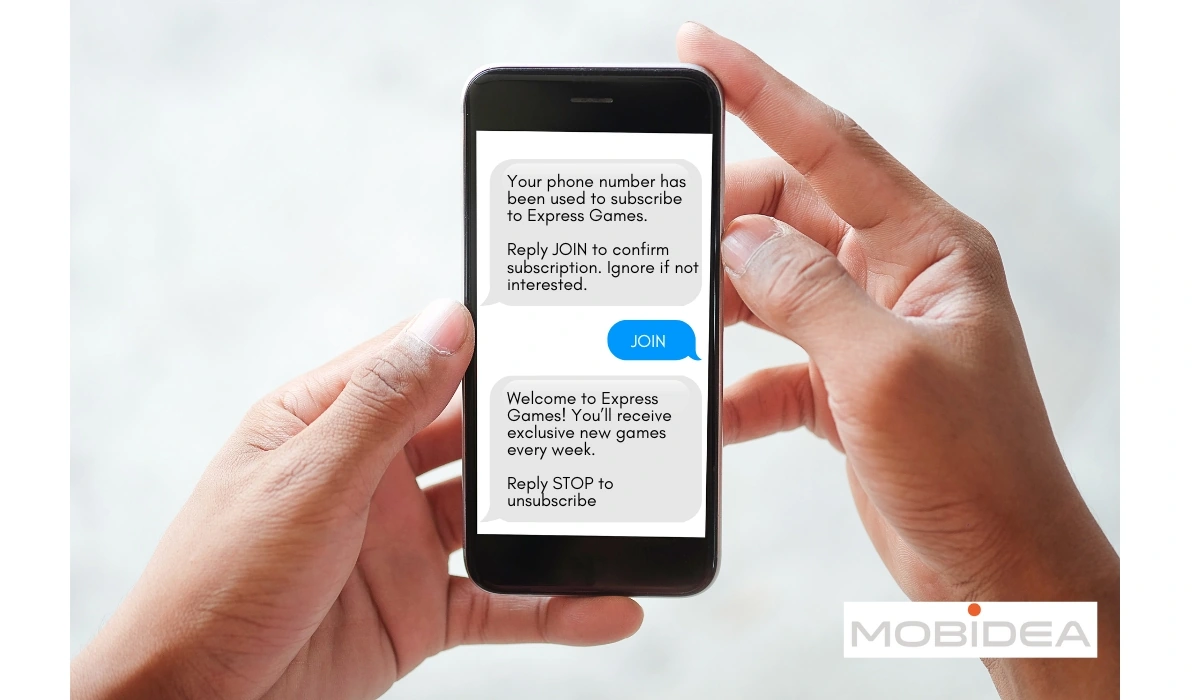
Quick note: Another Standard MO Flow utilized in the past is when the ad asks the user to send a code to a special number.
For instance, “send TONE to 12345” is pretty common.
However, these types are not applicable to affiliate offers since there is no way to track to whom the conversion should be attributed (unless the advertiser can provide a unique number to thousands of affiliates, which is not cost-effective).
-
- Click-to-SMS Flow
The Click2SMS flow integrates web interactions with SMS.
Step 1: The user clicks a link or button on a web page, which opens their SMS app with a pre-filled message and recipient number.
Step 2: The user simply sends the pre-filled SMS to confirm the subscription.
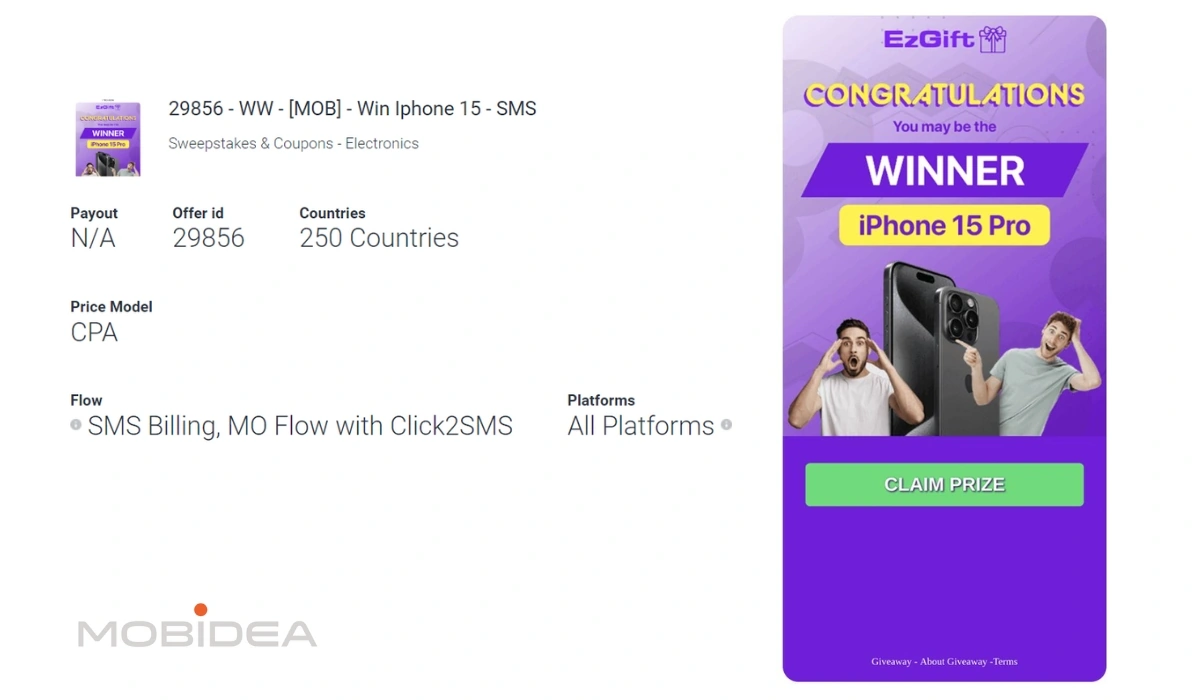
Example: A user clicks on a “CONFIRM SUBSCRIPTION” link on a fitness app’s promotional webpage.
Their SMS app opens with a message like “SUBSCRIBE” ready to send to a short code.
The user sends the message to complete the subscription.
-
- Click-to-Call
In the Click-to-Call flow, also known as IVR (Interactive Voice Response) flow, the user initiates a call to complete the subscription process.
Usually, the offer page shows a button that triggers the dialing app on their phone with a pre-filled number to call.
The user must place a call to confirm their subscription.
Once the call is connected, the subscription is activated, and the charge appears on their mobile bill.
Sometimes, advertisers would add specific metrics, like the user should stay on the call for at least a minute to trigger a conversion.
Mobile Terminated (MT)
In Mobile Terminated flows, the user does not need to send an SMS—he only needs to receive them and use the information there to confirm the subscription.
This is why it’s also called PIN Submit flow.
Step 1: The user initiates the subscription on a webpage by entering their phone number.
Step 2: The advertiser sends an SMS with a unique PIN to the user.
Step 3: The user enters the PIN on the advertiser’s webpage to confirm the subscription.
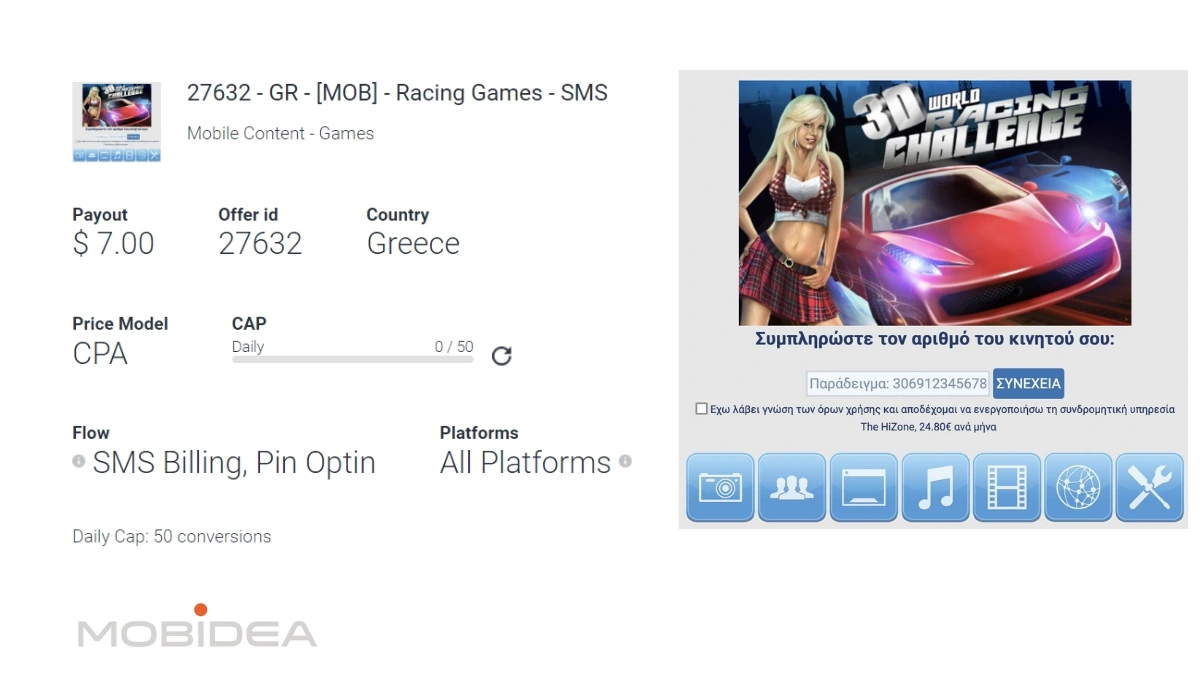
Example: A news service might ask for the user’s phone number on their website.
After the user inputs their number, they receive a text message with a PIN.
The user then enters this PIN on the site to confirm their subscription.
You Know the Flow!
You’ve made it through every major mVAS conversion flow—Direct Billing, SMS Billing, MO, MT, and everything in between.
By now, you should know exactly what happens between a click and a payout: which flows are fastest and which ones pay more.
That’s a big deal.
Because once you understand the flow behind an offer, you can finally make sense of things like payout differences, approval rules, and even why some campaigns convert better than others.
Here’s the good news: Mobidea has offers running on almost every one of these conversion flows across Tier 1, Tier 2, and Tier 3 countries.
MVAS is one of our best-performing and most profitable verticals, and we’re actually known for it. Try us!
But knowing the flow is only half the equation—the other half is getting the right traffic to it.
That’s exactly what we’re covering next.
Ready to put these flows to work?
Join Mobidea and start running mVAS offers with a network that knows this vertical inside and out.


We'll break down every major mVAS offer category and what makes each one tick, so you can pick the best one for your audience and skills!
Stop promoting mVAS blindly in Africa! Here's a full playbook on the best geos to start promoting in Africa right now and why.

Have a great mVAS offer to promote but don't know where to buy mobile traffic? We've narrowed down the best mVASad networks for you! Trust us—these are the ones proven to perform well with mVAS.