
Our friends at RollerAds talks about how to identify ad fraud and prevent them from ruining your campaigns.
Unless, of course, you’re running a complex campaign, where your first stage focuses on brand awareness instead of conversions.
In digital marketing, if any kind of fraud occurs, no party is safe from it; that’s why every reputable advertising network, like RollerAds, works hard to detect and prevent it.
But unfortunately, no matter what measures the network takes, occasionally some fraudulent source can sneak into the platform.
It doesn’t happen often, but it can happen nonetheless.
That’s why here at RollerAds we’ve compiled the definitive anti-fraud guide, so you can fight off fraud yourself!
Today, you’ll learn about types of fraud, their signs, consequences, how RollerAds fights invalid traffic, and what to do if you fall victim to a scam.
Ad Fraud Explained
To successfully fight your enemy, you must first know your enemy.
This is why we’ll start by dissecting some of the most common types of invalid and fraudulent traffic, and then go over exactly how ad fraud is harming our industry.
Bot Traffic
|
⚡This one is the most basic of them all: simple bots increasing traffic numbers from cheap data center servers. |
And because of their simple nature, all they can do is follow repetitive actions, like endlessly clicking on URL links, which makes them relatively easy to spot.
This kind of traffic might look active, but bots don’t buy anything, so no conversions at the end of the day.
Malware programs and unethical advertising
But bots can only get scammers so far, so this is where malware programs that simulate human behavior get into the picture.
As we found out, bot traffic can be relatively easily detected due to its simplicity; because of that, many fraudsters began routing their traffic through millions of compromised devices like phones, smart TVs, routers, anything that can be infected with malware.
|
⚡The whole process goes like that: an advertiser’s ad loads on the website, which triggers the system to render the said ad invisibly in the background on one of the compromised devices. |
Even though the end user never saw the advertisement, the media buyer still has to pay for the impression, since the ad was technically shown.
Click Farms and Incentivized Traffic
You’ve probably seen sweatshops with low-wage workers in crime and action movies.
Well, click farms are basically the same thing, with the only difference being that instead of producing illegal substances, those click farms complete target actions that are worth basically nothing.
|
⚡These workers are paid pennies to sit in front of devices and manually click links, scroll through feeds, install apps, fill out forms, and perform other tasks that require a “human” touch. |
Because of that, this type of invalid traffic is harder to spot, as real people indeed do all the actions, but they have zero interest in your ads beyond their small paycheck.
How Fraud is Harming the Digital Marketing Industry
Unfortunately, aside from some general figures, there’s no definitive data on how much affiliate marketing has lost to ad fraud, and even those estimates don’t paint a good-looking picture.
For example, in 2018, it was determined that total daily spending on fraud climbed to $17 million.
And in 2023, the market lost $84 billion to fraud, which is 22% of total online ad spending at that time.
If you thought that was bad, wait until you see the predictions.
Analysts expect that by 2028, the industry will lose around $170 billion.
And that’s not even taking into account the time and effort advertisers will waste.
Behind every stolen dollar hides the fruitless chase for fake leads, creatives optimized for phony engagement, retargeting budgets drained by nonexistent interest, and, last but not least, the loss of trust in metrics.
Fraud can also erode trust in advertising.
For instance, cookies can be replaced, skewing the attribution.
This has a huge impact on the industry, because fair advertisers do all the work and get penalized, while those who replace cookies reap the rewards.
In the long run, brands that allow such practice to exist end up without conversions and out of business.
This is why we believe, without exaggeration, that ad fraud is a silent killer of the digital marketing industry.
How RollerAds Combats Ad Fraud
|
⚡Because there’s no single metric that can detect fraudulent traffic on its own, our team has developed a set of 20+ technical metrics and several performance metrics. |
They evaluate each traffic channel against the others to determine whether it is valid.
According to our estimates, a quarter of all the potential traffic is fraudulent.
Gladly, our system masterfully recognizes and filters it out before it reaches advertisers.
Let’s take a closer look under the hood together and see how RollerAds’ fraud engine works.
The first step is the one that any serious network takes: pattern emulations, mismatched time zones, and signs of hijacked devices.
These are relatively easy to spot and catch before they ever reach an advertiser’s campaign.
After that, more than ten out of those 20+ technical metrics are directly tied to performance against the CPA goals that advertisers actually care about.
Even if the source seems squeaky-clean, it can still be blocked if “humans” don’t complete actions that will bring revenue.
If the traffic channel fails to deliver results and there’s no reasonable explanation for it, it will never be part of the RollerAds platform.
And the fraud detection system never stops, ensuring the safety of our partners and their marketing campaigns every step of the way.
And because it runs in the background, if anything comes up, the traffic source is automatically blocked, sometimes even before the advertiser can notice anything suspicious.
Signs of Invalid Traffic
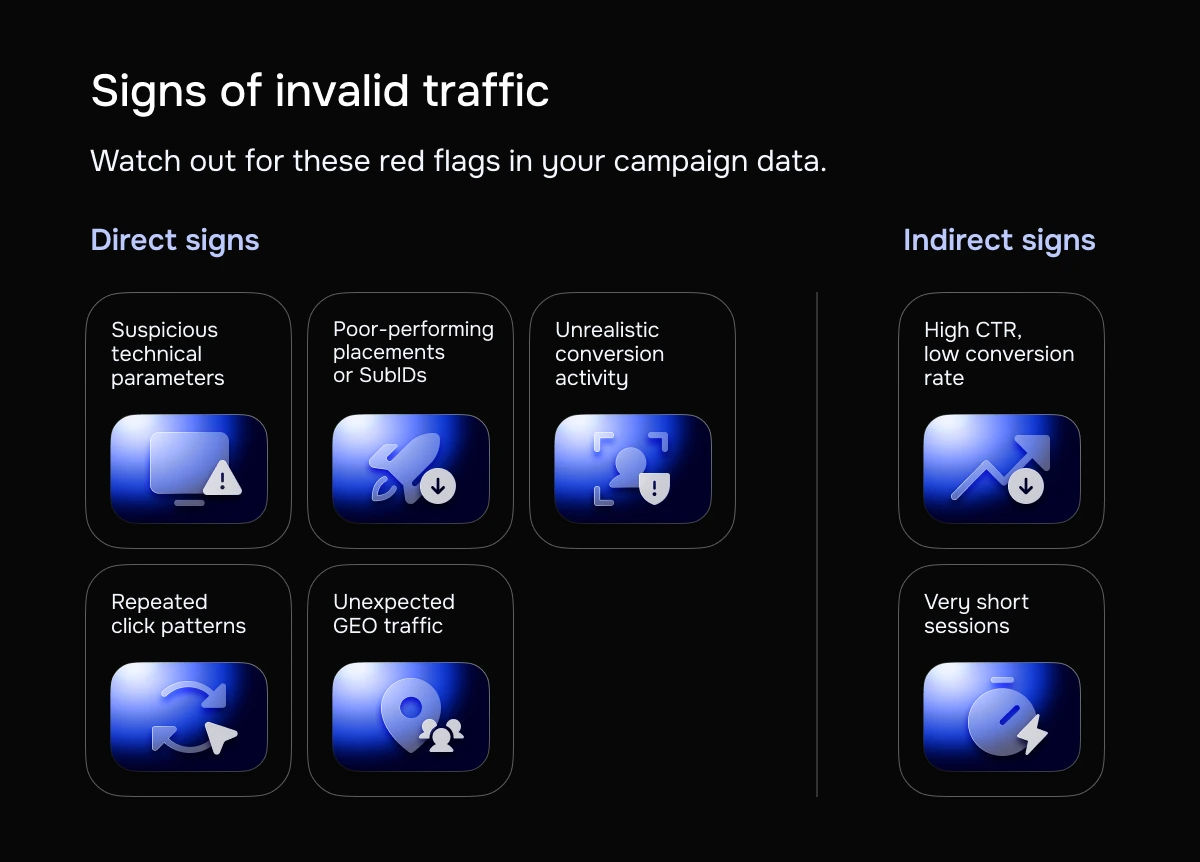
It’s good to know how to detect and handle fraudulent traffic if something slips in, just in case; that’s why we’ve compiled a list of the most common and reliable signs that indicate you’re getting scammed.
Source: RollerAds blog
Below, we’ll take a closer look at each of these warning sign groups and explain what they may indicate in practice.
First, we’ll go through the ones that show a high likelihood of fraud, also known as direct signs:
- Abnormal frequency and repeatability.
Bursts of clicks in short periods, equal intervals between actions, and multiple instances of them being done from the same IP, device, or user agent.
- Mismatch between GEO and campaign settings.
Traffic comes from non-targeted countries, data centers, VPNs/proxy, or from a GEO that does not match the targeted source.
- Strange technical parameters.
The data shows outdated or rare browsers, empty/referrer anomalies, identical screen resolutions, disabled JavaScript/cookies, and suspicious user agents.
- Poor quality across websites and subID.
One zone, placement, or subID shows significant differences in CTR, CPA, time on site, or post-click activity.
To figure out what is happening, you need to compare sources within the same attribution window.
- Unrealistic conversions.
If you notice many registrations but almost no email confirmations, profile completions, repeated sessions, or payments, then there’s a high chance of fraudulent activity that imitates simple target actions.
And now, let’s take a look at indirect signs.
These are usually the ones that, by themselves, can raise some eyebrows, but don’t outright indicate fraud.
If you notice them without the signs we listed above, we recommend inspecting your funnel first, then checking the traffic.
- Suspiciously short visits.
High bounce rate; users spend only several seconds on the website; only one page is viewed; no scrolling; and other identical, recurring scenarios.
- Lots of clicks with almost zero completed target actions.
The CTR may be high, but the number of registrations, deposits, purchases, or other target actions is noticeably lower than usual.
Before moving forward, we highly recommend treating the signs above as a package.
For example, a high bounce rate can occur due to poor targeting, but it is another story if you notice that, let’s say, those short visits come from outdated browsers and from the same IP.
We also advise monitoring the source for a little while, as it performs well but shows a couple of signs of fraud, to see whether they continue to appear or were merely random errors.
But if they persist, or worse, you observe all of the features of invalid traffic from this section, then you have definitely encountered ad fraud.
What To Do if You Suspect Poor-Quality Traffic
But there’s no need to fret if you suspect ad fraud; you must do as follows:
- If you work with RollerAds/any well-known advertising network, contact the support team or your personal manager immediately.
And… that’s all what you have to do in case you’ve become a victim of ad fraud.
But if you feel that’s not enough, you can help our team by also:
- Checking the domains (whether they open and redirect, and whether the links open) and going through the funnel yourself from start to finish.
- Providing the tracker stats, clicklog (agent, IP, etc.), and LP CTR.
Tracker data isn’t required for investigation, but it can significantly help us eliminate the problem faster.
That’s why we highly advise you to set up a tracker in advance and use it with all your campaigns.
But don’t expect that you’ll deal with fraud on a daily basis.
Reputable advertising networks, like RollerAds, care about their partners and image in the business; that’s why they thoroughly check every traffic channel before allowing it on the platform and won’t knowingly sell invalid traffic.
Besides, today you saw for yourself how seriously we take the issue.
So, think of this article as a little basic CPR lesson.
You may not encounter ad fraud in your lifetime, but if you do, you’ll be glad to know what to do.
Instead of Conclusion
Ad networks are in a constant arms race with fraudsters: scam tactics evolve, but so does the defense system.
The RollerAds team continuously improves our advanced anti-fraud system with new metrics to keep our partners safe and malevolent actors at bay.
When it comes to preventing ad fraud, we’re not stopping at “good enough” and striving for greatness, but even with our best efforts, it can still occur.
That’s why, if you feel you’re getting invalid traffic, feel free to write to our support team or your personal manager, because RollerAds cares about its partners and is always here to help.
In the end, if you’re looking for a reliable advertising network with top-quality traffic and the best anti-fraud system in the business, consider joining RollerAds.
Let’s roll to the fraud-free future together!



Push, Pop, or Direct Click—which one actually pays off? The RollerAds team breaks it all down, GEO benchmarks and all, so you can pick the format that fits your next campaign.

Learn how to be successful in affiliate marketing with KJ Rocker, an affiliate marketing pro!

Emanuel Cinca is a true affiliate pro and STM's Head of Business Operations so you know this interview is impossible to miss!