
Push, Pop, or Direct Click—which one actually pays off?
The RollerAds team breaks it all down, GEO benchmarks and all, so you can pick the format that fits your next campaign.
Advertisers often ask us about which ad format is better to use in their marketing campaigns: Push, Pop, or Direct Click.
That’s a good and simple question, but it has no simple answer to it, because you need to account for rates, your budget, your willingness to polish angles, and more.
Today, we’ll talk about the essence of each format, its use cases, and RollerAds experts’ recommendations for 2026. Let’s begin, shall we?
What is Push traffic (and why affiliates still love it)
First, let’s take a closer look at each ad format and elaborate on the corresponding traffic type.
Push traffic refers to users who were directed to a landing page via notification-style ads.
Push traffic works in a few straightforward steps:
1. The opt-in. Before the ad is displayed, the user must give explicit consent, typically via an “Allow to receive notifications” prompt or similar.
If the user allows them, they will be added to a subscriber database.
2. Campaign creation. Advertiser creates a marketing campaign that uses the Push ad format.
3. Distribution. When the campaign is launched, all the subscribed users receive the appropriate notification on their devices.
4. Conversion and monetization. If the subscriber clicks the ad, they will be redirected to the destination chosen by the advertiser during campaign creation, which can be a landing page, product page, or app store page.
After that, the user completes a target action that generates revenue for the advertiser.
As for the format’s distinctive features, the most common bidding models are CPC, SmartCPC, and CPA Goal.
Because Push ads leverage the device’s native user interface, they seamlessly blend with other messages.
Generally, Push notifications require a small creative alongside a bit of text.
In one of our case studies, we tested each bid model within similar Push campaigns to discover which ones work best for initial testing and which are more effective for scaling.
Dive in to explore the full process of launching, optimizing, and scaling successful campaigns.
What is Pop traffic
Pop traffic (OnClick) is a type of traffic in affiliate marketing that is generated when users are redirected to ads that open in a new window or tab.
Depending on the setup, they can open either in front of the active tab as pop-ups or behind it as popunders.
Here’s how Pop traffic works:
1. Campaign creation. Advertiser creates a marketing campaign that uses the Pop (OnClick) ad format.
It’s worth mentioning that such campaigns don’t need any creatives.
2. The trigger. A user visits a website that has a script that triggers a Pop ad and clicks anywhere on the page, which in turn opens the ad itself.
It should be noted that this kind of trigger is typical, but there are more.
For example, a timer or an ad might open when the exit button is clicked specifically.
3. Conversion and monetization: Pop ad strategy. Choose pop-ups when your main goal is maximum visibility and immediate user attention.
Popunders, on the other hand, offer a less intrusive experience by opening behind the active tab and allow users to view them later without disrupting their browsing.
This makes them particularly effective for retargeting and re-engaging previous visitors.
Usually, advertisers use either CPM, Smart CPM, or CPA Goal bidding models with Pop traffic.
Unlike Push ads, as we mentioned earlier, Pop ads are free from creatives, except for the landing page.
This, in turn, makes them the easiest to implement.
What is Direct Click traffic
Direct Click format is somewhat similar to Pop ads, as it also operates like a pop-up window or tab.
This ad type has three traffic channels: Survey exit traffic, Parked domain traffic (our biggest driver), and High-engagement clicks (e.g., from “Play”, “Download”, or “Continue” buttons).
The Direct Click mechanism works like this:
1. Campaign creation. Advertiser creates a marketing campaign that uses the Direct Click campaign (you can watch the dedicated video on our YouTube channel to learn more about this ad format).
2. Redirection. A user performs an action that activates the advertiser’s offer.
For example, they might accidentally mistype a search query and land on a parked domain.
Instead of seeing a blank page, the user is redirected to an ad relevant to their search.
3. Conversion and monetization. Upon arriving at the page, the user performs an action that generates revenue for the advertiser.
Because of the format, it attracts only engaged clicks, which directly result in maximum conversions.
When it comes to bidding models, both CPC and SmartCPC are available.
Earlier, we said that parked, expired, or typo domains are our biggest generators of Direct Click traffic, and for a reason.
Compared to traditional display ads, when users search for something specific, they already have a high intent of interacting with the product you’re promoting, whether it be purchasing it or downloading an app.
And as for the creatives, this ad format is somewhat creative-free; all you need is the landing page (pre-lander).
Which ad format actually makes money?
As we said at the beginning, there’s no ad type that will fit any marketing campaign. When choosing a format, you must consider:
- Offer type. The right ad format better communicates the product’s value to the potential customer.
- GEO tier. Different regions have different spending power, so high-impact, immersive formats will work better in Tier-1 and Tier-2 countries, while simple, low-cost, but high-volume ads are great for Tier-3 countries.
- Funnel strength. Consumers’ purchase intent also plays a huge role when deciding on an ad format.
- Budget size. Aligning your budget with the right format ensures you aren’t wasting resources on impressions that don’t convert.
And don’t forget about A/B-testing.
If you can’t decide between a couple of formats after reviewing the points above, you can test two similar campaigns with different ad types to see which performs better.
In addition, we regularly analyze noteworthy cases from our practice and publish them on RollerAds’ blog.
So if you need some inspiration for your future marketing campaigns, you now know where to find it.
Winning strategies for Push, Pop, and Direct Click campaigns
Before ending the article, we want to share with you insights on what verticals work best with each format, and also show some data and juicy numbers for each ad type discussed today from RollerAds’ experts.
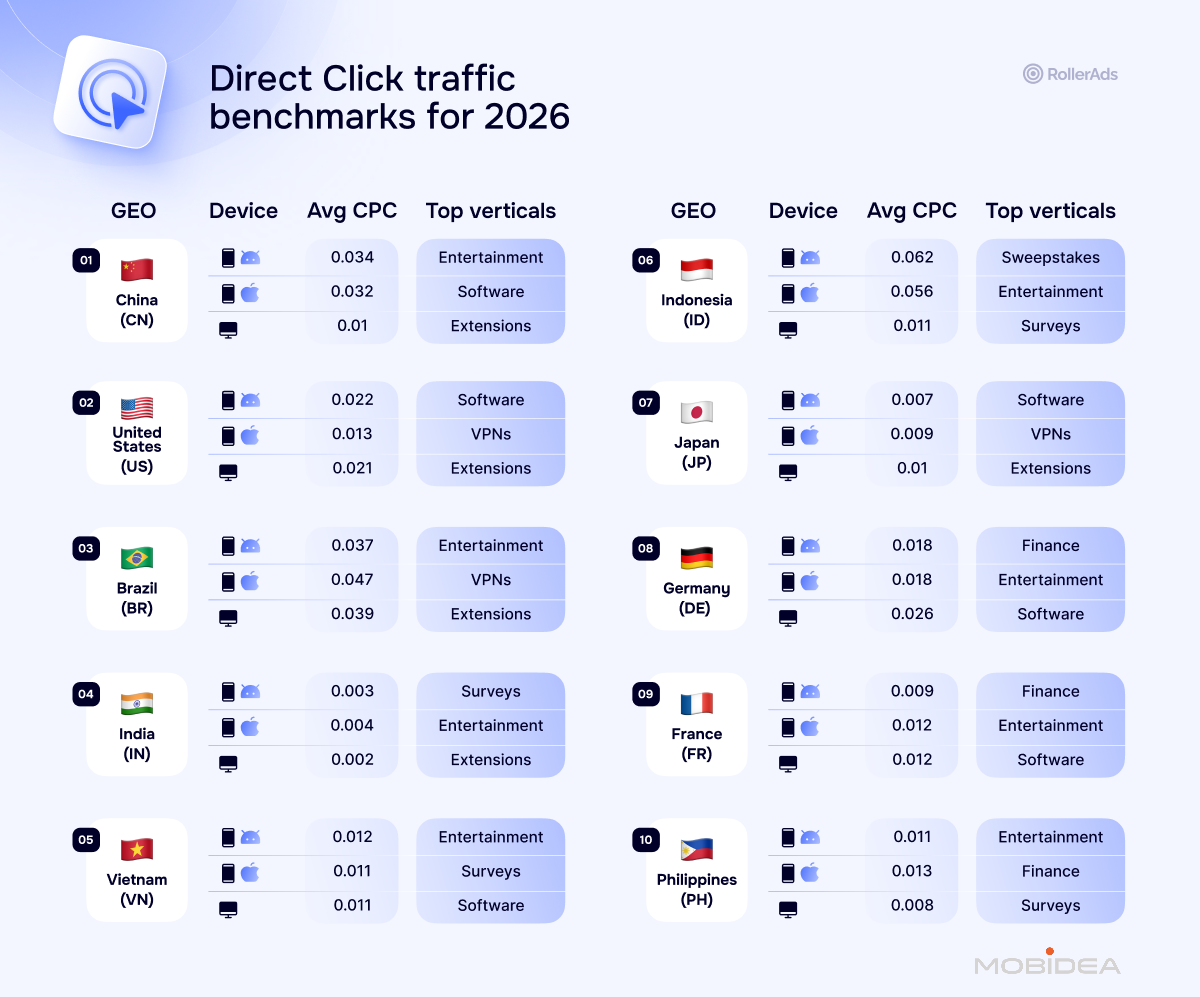
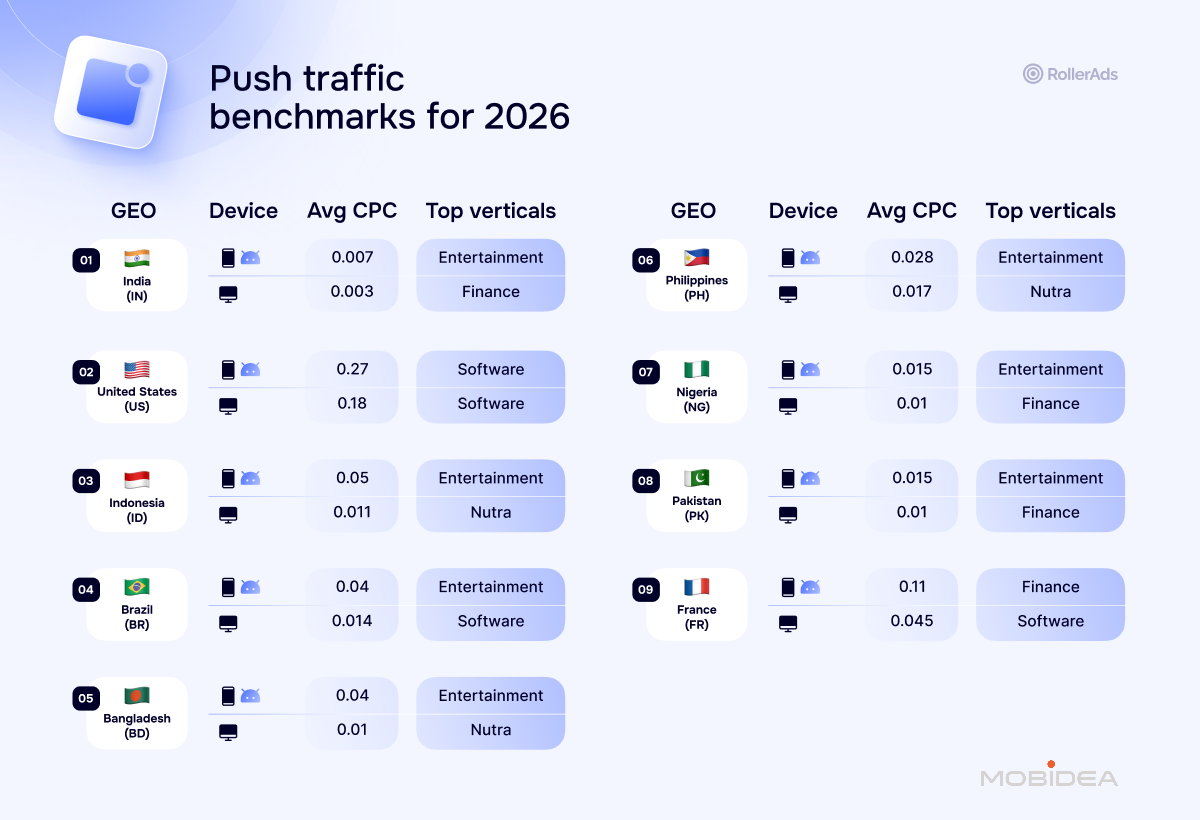
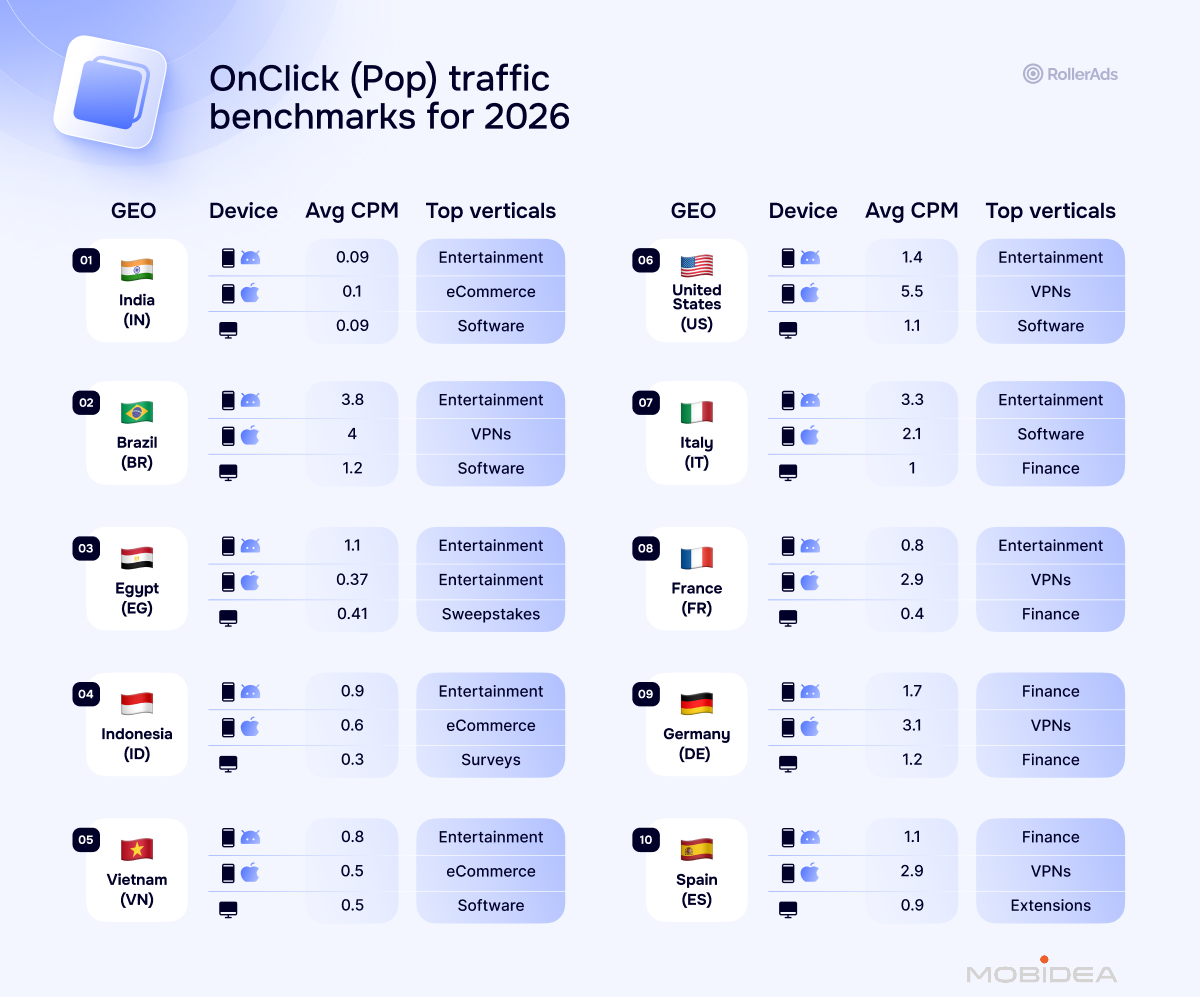
Push, OnClick (Pop), and Direct Click traffic benchmarks for 2026
And as for the data, numbers, and insights, here is some information from RollerAds’ experts on every ad format mentioned, with recommended CPC/CPM ranges for each GEO, traffic type, and vertical:
Final thoughts
As of now, the affiliate marketing industry has yet to come up with a universal ad that fits any campaign like a glove, but that doesn’t mean we don’t already have some great formats.
Today, we reviewed Push, OnClick (Pop), and Direct Click, some of the most popular ad types in the market, together with the right verticals and proper bidding for them, so you can start launching profitable campaigns right away.
And if you still have some questions, or have never worked with any of the ads listed above but want to try them out, consider joining RollerAds, the ad network with the top-performing ad formats and the most responsive support team on the market!


RollerAds’ case study for Mobidea: CPC vs. SmartCPC—which bidding model is better for early tests.
Learn how RollerAds Landing Page Service helps affiliates reduce bans, protect subscribers, and maintain stable performance with minimal setup and zero maintenance costs.
The RollerAds team shares with us what's really happening with Web Push advertising right now, including the policy changes that shook the industry and why the format still has a future for savvy marketers.