What is CPA Affiliate Marketing?
Last updated on September 22, 2026 8 min read
There are two important concepts when looking into CPA affiliate marketing: CPA and affiliate marketing.
You possibly already know what affiliate marketing is—a marketing strategy where an advertiser pays a third-party to promote their products or services.
It’s one of the most popular ways to make money online, although many people have only ever encountered the CPS and Revenue Share option, where they only get paid after a sale.
There’s more to that with CPA marketing.
To break into this industry, you need to understand the ins and outs of it.
Let me help you there.
What is CPA?
CPA can mean two things, and both are correct:
- Cost Per Action – You get paid when someone takes a specific action
- Cost Per Acquisition – You get paid when someone becomes a lead or customer
Most people use these terms interchangeably, and for our purposes, they mean the same thing: you earn money when someone completes a desired action through your promotional efforts.
What counts as an “action”?
The beauty of CPA marketing is that actions can be almost anything:
- Email submit (just entering an email address)
- Form fill (completing a lead form with contact info)
- App install (downloading and opening an app)
- Free trial signup (no credit card required)
- Account registration (creating a free account)
- Phone call (calling a business)
- Game play (playing a mobile game)
- COD purchase (cash-on-delivery purchases that don’t require a credit card)
- Paid Subscription (initial subscription to a service; can also be trial subscription)
- Initial deposit (common in Gambling and Betting platforms)
Notice something?
Many of these require the person to spend money.
Majority of the CPA affiliate offers right now focus on customer acquisition first, payment later.
Of course, there are also some that require initial purchase.
How does CPA Marketing Work?
It’s very much like typical affiliate marketing, except it often has an additional player: the CPA Network.
And the conversion is based on the desired action we discussed above.
|
🚀 Author’s Note: When I say conversion, it simply means the desired action has been performed. |
You’d have to get used to this word since it’ll be thrown around a lot not just in this article, but in our industry as a whole.
The Four Players
So we’ve established that we have an extra player, the CPA network, but let’s mention all of them to make it complete:
- Advertiser – The company with a product or service they want to promote
- CPA Network or CPA Affiliate Network – The platform that connects advertisers with affiliates (that’s you)
- Affiliate (Publisher) – You! The person who promotes offers and earns commissions
- User – The customer who performs the desired action
The Flow
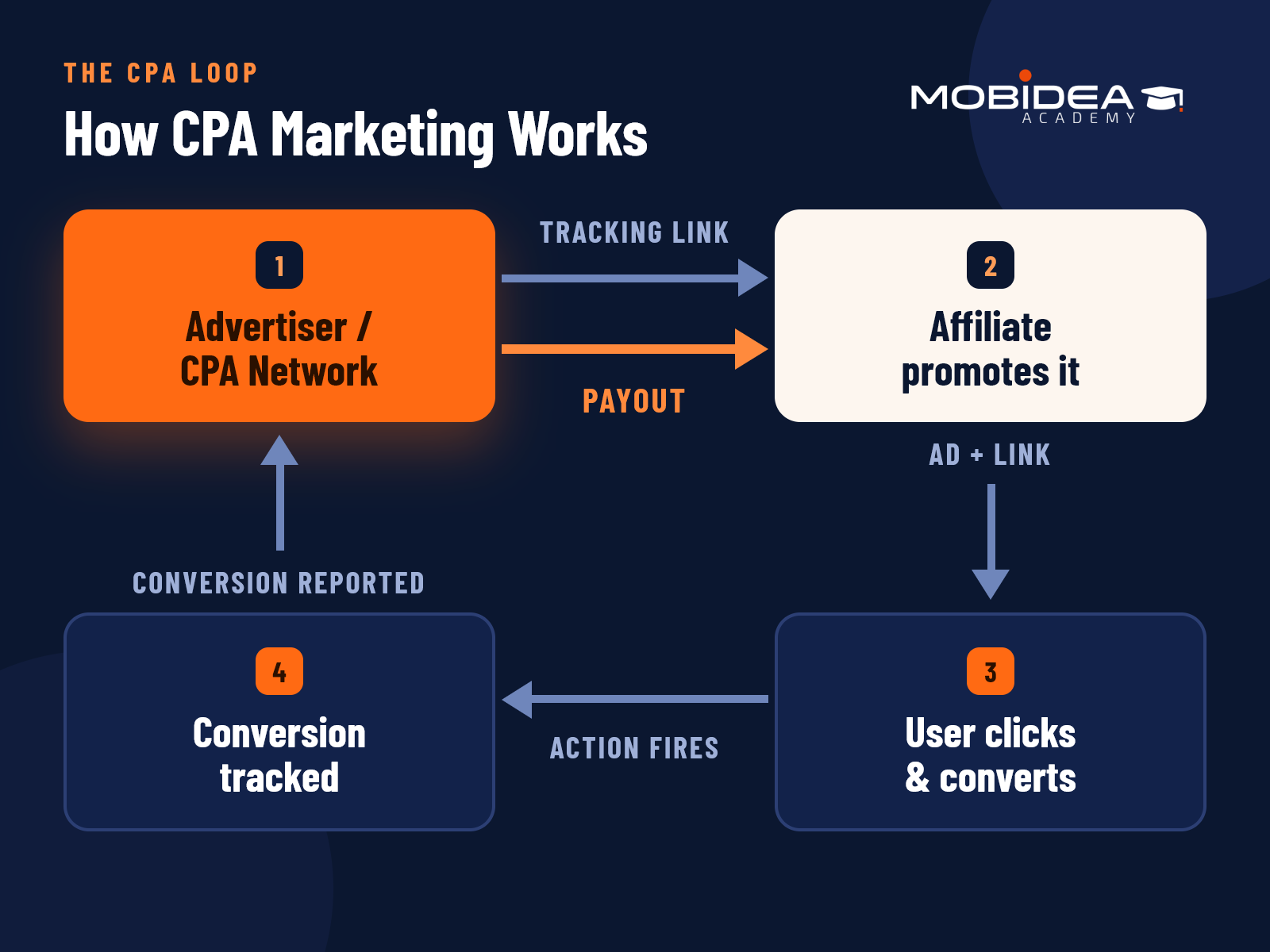
Here’s how CPA affiliate marketing works:
- The advertiser or CPA network gives the affiliate a unique tracking link for the offer
- The affiliate promotes the product or service, making sure to add their unique tracking link in the promotion
- A user sees the promotion, clicks on the link, and performs the desired action
- The advertiser or CPA network is notified of the conversion
- The advertiser or CPA network pays the affiliate
|
🚀Author’s Note: The offer or affiliate offer is how we refer to each “CPA item” being promoted or “offered”. |
It’s another thing you’ll be hearing this a lot in the CPA marketing industry, so better get used to it!
Now for the sample.
Let’s say a fitness app wants more users.
They go to a CPA network and say, “We’ll pay $2.50 for every person who downloads our app and creates an account.”
You join that network, grab your unique tracking link for that fitness app offer, and share it with your audience.
When someone clicks your link and completes the signup, you earn $2.50.
The advertiser gets a new user, the network gets paid by the advertiser for connecting you two, and you make money.
Everyone wins!
Why Use a CPA Network?
Why work with affiliate sites and not just work directly with an advertiser?
That is a sound question, and many super affiliates actually go that route.
But if you’re a newbie, with zero or minimal previous experience to promoting affiliate program offers, let alone a specific niche or brand, then why should a brand trust you?
It’s easier for an advertiser to work with just one good CPA network and have that network handle thousands of affiliates.
There’s a lot of work that comes with handling a CPA affiliate program, which often, an advertiser would rather not handle.
The affiliate network would take care of managing affiliates, monitoring conversions, pay affiliates, and so on.
That’s just good business sense.
For the affiliate, it’s also better to work with reputable CPA networks because you can work on several CPA campaigns at the same time.
You can even get dedicated account managers, which can be a lifesaver at times, I tell you!
If you’re looking for the top CPA affiliate networks, check this out:
Which is better: CPA affiliate marketing vs Traditional Affiliate Marketing?
Neither—they serve different purposes.
CPA is great when you want quick wins and have traffic that might not be ready to buy (well, for some offers, that is).
Traditional affiliate marketing (CPS – Cost Per Sale) works better when you have a loyal audience that trusts your recommendations.
Many successful affiliates do both, choosing the right model based on their traffic source and audience.
Key CPA Terminology You Need to Know
Here are some terms you’ll see mentioned throughout your life as a CPA affiliate:
- Vertical – The category or industry of an offer (Dating, Nutra, Finance, etc.)
- Niche – The subcategory of the vertical (for example, Dating is the main vertical, casual dating is the niche)
- Commission – How much you earn per action completed
- EPC (Earnings Per Click) – Average amount you earn for every click you send (higher is better)
- Conversion Rate – Percentage of clicks that turn into completed actions
- Compensation Types or Payment Models – CPA networks may offer various compensation types beyond CPA, such as Cost-Per-Lead (CPL), Cost-Per-Sale (CPS), Cost-Per-Install (CPI), and Revenue Share
- Cookie Duration – How long your tracking link stays active (30 days, 60 days, etc.)
- Payment Threshold – Minimum amount you need to earn before getting paid (often $50-$500)
- Payment Frequency – How often the network pays you (weekly, bi-weekly, monthly)
- GEO – Geographic location/country where the offer is available
- Landing Page – The page people see after clicking your affiliate link
- Sub-ID – A tracking parameter you can add to test different traffic sources
- Direct linking – sending traffic straight to the offer, without using a landing page
Want to learn more?
This is just a quick overview to get you started.
For a deeper dive into CPA marketing strategies, how to choose offers, what traffic sources work best, and advanced optimization techniques, check this out:
Frequently Asked Questions in CPA Affiliate Marketing (FAQ)
Do I need landing pages for CPA affiliate marketing?
Not always, but they help significantly.
Direct linking works for some campaigns, but landing pages typically improve conversions by:
- Pre-selling the offer
- Building trust
- Filtering unqualified traffic
- Providing more information
- Increasing engagement
Some CPA programs and traffic sources require landing pages.
Test both approaches—sometimes direct linking wins, sometimes landing pages perform better.
How long does it take to make money with CPA marketing?
There’s no definite timeline. It depends on your experience, your budget, your traffic source, even the offer you are promoting!
Some people make money faster, some slower.
It’s not a “get rich quick” thing—expect 3-6 months to see solid results.
What’s the biggest mistake beginners make?
Top mistakes:
- Promoting too many offers at once (focus on 2-3)
- Not tracking properly (you can’t optimize what you don’t measure)
- Giving up too quickly (testing takes time)
- Choosing offers based only on payout (conversion rate matters more)
- Ignoring affiliate manager advice
- Not reading offer restrictions
- Spending too much before testing
- Copying others without understanding why it works
Do I need a big budget to start with CPA affiliate marketing?
Not necessarily.
Budget options:
- $0: Free traffic (SEO, social media, content marketing)
- $100-$500: Test small paid campaigns, learn basics
- $1,000-$5,000: Serious testing and scaling potential
- $5,000+: Professional level, faster scaling
Start with what you can afford to lose—this is very important!
Many successful affiliates started with under $500 and reinvested profits to scale.
How much money can you make with CPA marketing?
It varies wildly. Complete beginners might make $0-$500/month while learning.
Intermediate affiliates typically earn $1,000-$10,000/month.
Advanced CPA affiliate marketers can make $50,000-$500,000+ monthly.
Your earnings depend on your traffic volume, traffic quality, offer selection, and optimization skills.
Most people don’t get rich overnight—it takes testing, learning, and scaling what works.
Is CPA affiliate marketing still profitable today?
Yes, very much so.
If it’s not, this industry would not be expanding as it is now.
CPA marketing specifically remains one of the most popular models because it’s lower risk for advertisers (they only pay for results) and easier for affiliates (lower barrier than sales).
As long as businesses need customers, CPA marketing will be profitable.
Can beginners start CPA marketing?
Absolutely.
Many networks specifically welcome beginners (such as Mobidea).
Start with beginner-friendly networks, choose simple offers, test small campaigns, and learn as you go.
You don’t need thousands of dollars or years of experience—just commitment to learning and testing.
Most successful CPA marketers started exactly where you are now.
What’s the difference between CPA and affiliate marketing?
CPA marketing is actually a type of affiliate marketing. The difference is in the payment model.
Traditional affiliate marketing usually means CPS (cost per sale)—you only get paid when someone buys.
CPA marketing pays you for actions that don’t require a purchase (email signup, app download, form submission).
CPA typically has lower payouts per conversion but higher conversion rates.
How often do CPA networks pay?
Payment frequency depends on the network.
The most common ones are as follows:
- Daily
- Weekly
- Bi-weekly
- Monthly
There are also some additional payment terms aside from the frequency, and these are:
- Net-7
- Net-15
- Net-30
These mean you get paid the indicated days after the end of the payment period.
For instance, if the frequency is monthly and is on Net-7, it means you’ll get paid 7 days after the end of the month.
What payment methods do CPA networks offer?
Common payment options:
- PayPal (most popular, fastest)
- Wire Transfer / Bank Transfer
- ACH (US bank transfer)
- Payoneer
- Paxum
- Bitcoin / Crypto
- Check / eCheck
- WebMoney
International affiliates often prefer PayPal or Bitcoin for faster, cheaper transfers.
Make sure you double check that the network of your choice can pay you in payment options you prefer or those that are available in your region.
How do I find the best CPA offers to promote?
Methods to find winners:
- Check your network’s “Hot Offers” or “Top Performing” section
- Ask your affiliate manager for recommendations
- Look at EPC (higher is usually better)
- Use spy tools to see what others are running
- Test multiple offers in your niche and track results
- Join affiliate forums to see what others are promoting
- Start with offers that match your traffic source and audience
What are private/exclusive offers?
Private or exclusive offers are only available to certain affiliates or a single network.
Its benefits include higher payouts (less competition), and better conversion rates (audiences are not burned out).
Is buying traffic necessary for CPA marketing?
Not necessary, but it helps you scale faster.
You can succeed with:
- Free traffic: SEO, social media, YouTube, forums (slower but zero cost)
- Paid traffic: pop ads, push ads, in-page push ads, banner ads, social media ads, Google ads, native ads, adult traffic, video ads, Telegram ads, etc.


An offer's flow is crucial since it really does have an impact on conversions. Read all about mobile billing in this post!

There are lots of different affiliate payment methods online that marketers can select! Check this Mobidea Academy analysis and take your pick!

A media buying strategy is the most important thing you must bear in mind! Check how you can create a killer media buying strategy!