Web Push Advertising In 2026: Still Worth It or Time To Move On?
Last updated on June 24, 2026 4 min read
The RollerAds team shares with us what’s really happening with Web Push advertising right now, including the policy changes that shook the industry and why the format still has a future for savvy marketers.
Web Push has been our specialty for quite a while, and if there’s one thing to say about it right now, that would be impermanence.
One month, you’re seeing great performance and growing budgets.
The next, shifts in platform policies occur: unsubscribe rates soar, users leave, and all industry players wonder if there’s any future to this format.
The short answer is yes, the Web Push format lives on.
But there are a number of nuances to it, and we’re going to elaborate on the main ones.
Web Push advertising is not the same as it used to be, but it can be profitable if approached right.
Let’s start from the beginning.
What led to changes: 2024–2025 lookback
Major changes to Web Push began back in late 2024.
This is when Google made unsubscribe options more visible on Android and strengthened its Safe Browsing principles.
The company also started cracking down harder on spammy, intrusive, or misleading content.
Many platforms felt the change, RollerAds was among them.
We detected the unsubscribe rate jumping up to 30–40% on our platform alone.
Publishers saw shrinking user bases, and revenue took a deep dive across the whole industry without exceptions.
Even if we managed to get a grip on the situation, these changes marked the beginning of a major structural reset.
That process is still ongoing in 2026, though there is a silver lining.
Let’s look at the market research and forecast in numbers.
The Web Push market growth insights
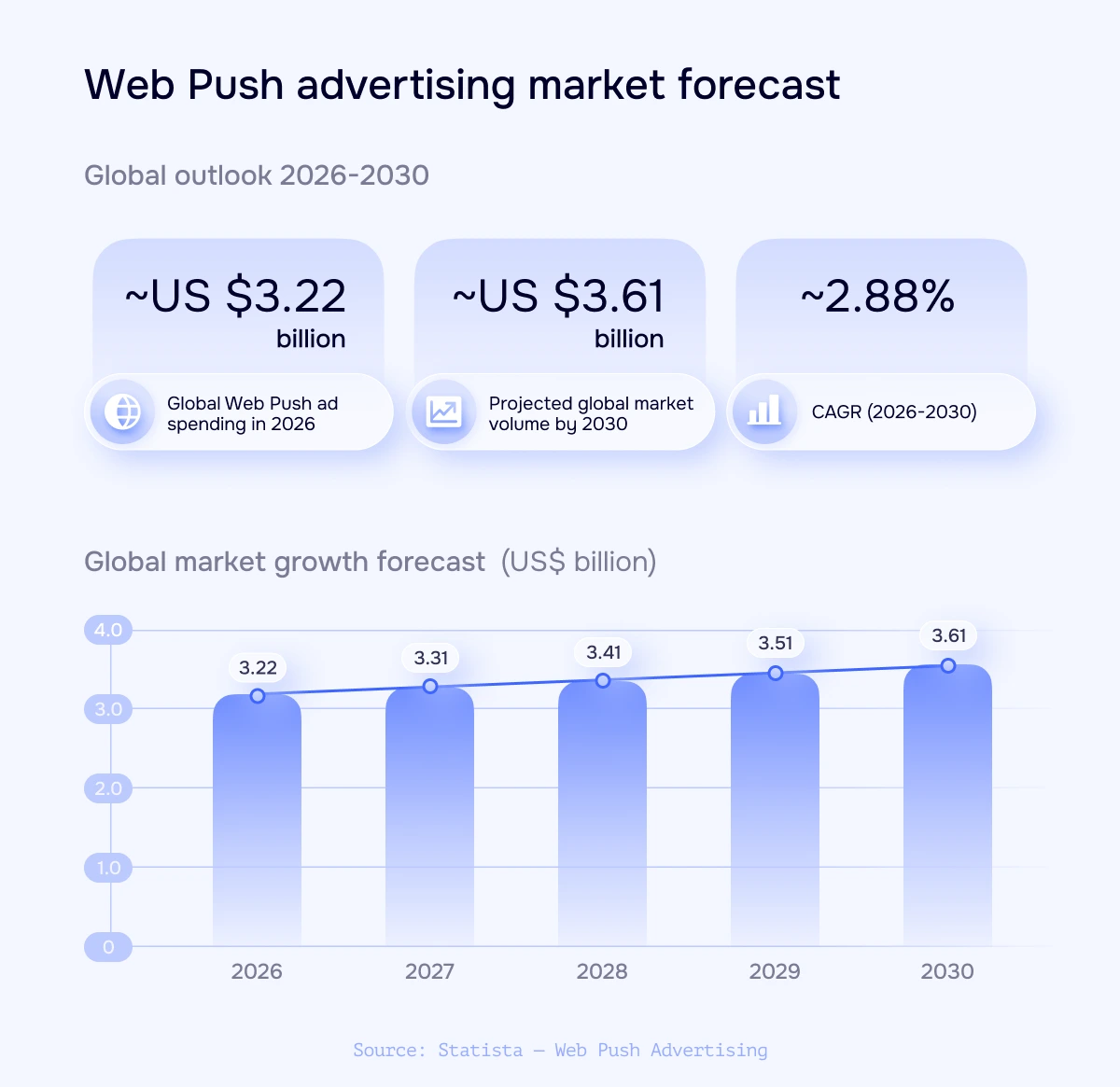
According to Statista’s Web Push Advertising Worldwide research, global Web Push ad spending is expected to grow from $3.22B in 2026 to $3.61B in 2030.
That’s a CAGR of around 2.88%. Not the explosive numbers we used to see, but steady growth.
Source: RollerAds blog
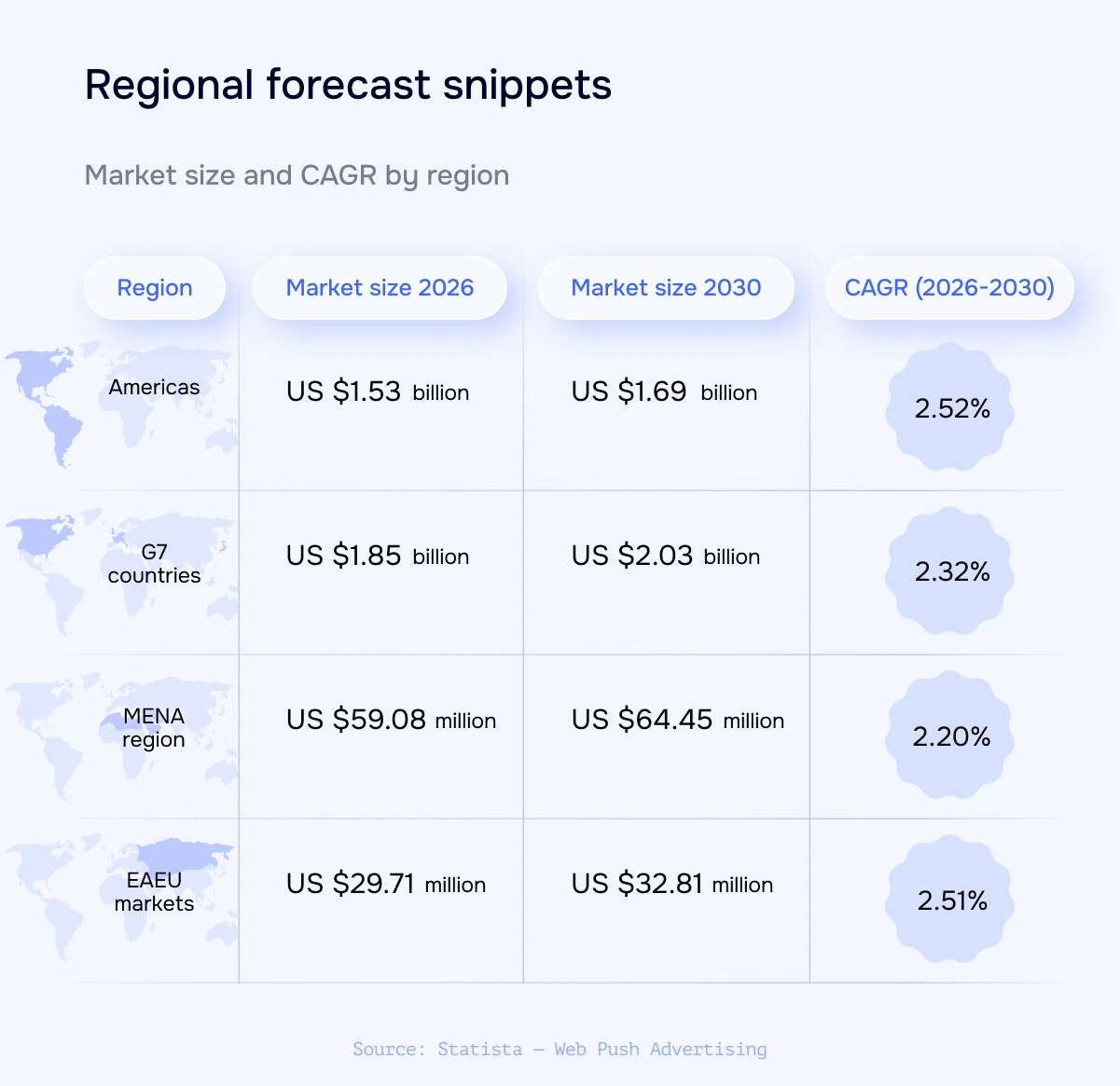
This general trend of steady growth is further supported by various regions.
- Americas:
~US$1.53 billion (2026) → ~US$1.69 billion (2030), CAGR ~2.52% - G7 countries:
~US$1.85 billion (2026) → ~US$2.03 billion (2030), CAGR ~2.32% - MENA region:
~US$59.08 million (2026) → ~US$64.45 million (2030), CAGR ~2.20% - EAEU markets:
~US$29.71 million (2026) → ~US$32.81 million (2030), CAGR ~2.51%
Source: RollerAds blog
What we see here is that the market isn’t ceasing.
It’s moving from fast expansion to more steady, gradual growth—a normal reset in the wider digital ad ecosystem.
At the same time, things are slowing down because of stricter policies, stronger privacy rules, and more platform limits.
This doesn’t stop growth, but it does change how quickly and in what way the channel can scale.
The industry is becoming more performance-driven
The trend happening right now is that lower-quality traffic sources are gradually disappearing, while more compliant and performance-focused players are gaining stronger positions.
This process can temporarily affect traffic volumes, campaign costs, and overall delivery stability.
At the same time, fewer low-quality messages mean users experience less notification fatigue.
Over time, this typically leads to:
- better engagement
- stronger CTR
- improved conversion quality
- higher long-term value per subscriber
Data from our platform shows a noticeable improvement in user engagement over the last few years, with CTR levels growing by roughly 1.5–2x.
While these insights are based on internal analytics, similar patterns can be seen across the wider Web Push landscape, which clearly points to a gradual shift toward more engaged and higher-quality audiences.
All this means that the Web Push ecosystem is steadily moving away from a pure volume model toward a more ROI-focused approach.
Today, success depends less on sending the largest number of notifications and more on delivering relevant content to engaged users.
To stay competitive, advertisers and traffic providers are increasingly focusing on:
- smarter targeting
- audience quality
- funnel optimization
- LTV-based strategies
- sustainable campaign performance
Overall, the market is not shrinking—it is evolving into a more mature, quality-driven advertising channel.
Wrapping up
The market of Web Push won’t disappear, not now at least.
Instead, it’s evolving, and marketers who can engage and provide real value will skim the cream.
RollerAds is always there to help our partners navigate regulatory changes and adapt to a new reality.
We’ve been updating our tools to adjust to the tightening standards, and we’re proud to say that Web Push advertising still converts, at least on our platform.
Register on RollerAds and let’s talk about how to make it profitable again in this new environment.
It’s not the easiest time, but real opportunities still exist, and we know how to reveal them in the best way possible.



RollerAds’ case study for Mobidea: CPC vs. SmartCPC—which bidding model is better for early tests.

Learn how RollerAds Landing Page Service helps affiliates reduce bans, protect subscribers, and maintain stable performance with minimal setup and zero maintenance costs.

Learn how to monetize a blog with affiliate marketing and explore this super profitable profession!